Saturday, 30 January 2010

Unintentional Frugal Gaming

Dave the Frugal Gamer set a challenge for these financially straitened times early last year. To whit:

pay less, play more, and try new games.

I'd like to take a moment to see how I stack up as a frugal gamer. Please indulge me (or leave abuse in the comments).

Pay Less
Switching from high production value, high street games (WOTC 3E, WFRP) to the less glossy, but often more useful, hobbyist products of the OSR has definitely shifted the spend/play value ratio in favour of play. As for price, totting it all up (books, pdfs, minis and plastic monsters) I come out with a grand total spent on gaming for the period Jan-Dec 2009 of:

£81 (and change).

£81?! That's chicken feed! It works out at about £6-7 a month (a bit less than the price of a paperback or DVD here in the UK). To put that into a more hobby-specific perspective:
  • a Games Worshop starter army box is £50 retail,
  • the D&D 4E Core rules set is £75-80 (although WOTC's new Essential D&D Essential Starter Essential Series releases might lower the ticket point to play in their particular walled garden a little),
  • the new Space Hulk and FFG's WFRP(INO) are £75 and ~£100 respectively.
Of course, thanks to the generosity of the grognosphere I did get for free a lot of stuff that, by rights, people could fairly have charged for. But hey, their insufficiently lauded generosity* is my gain. I'm too busy filling my boots to look the gift horse in the mouth. ;)

Play More
We certainly seem to be. Games are still only weekly, but we're getting a lot more done in the few hours we can steal from the world of tedious grown up concerns.

The various labour-saving devices created or rescued from obscurity by the efforts of the myrmidons of the OSR (sandbox hexcrawls, one page dungeons, random tables, the aforementioned buckets of good free content) have allowed me to DM smarter, faster, and with less wear-and-tear on the old grey matter. Cheers lads!

Of course the single biggest liberator of my time was switching my primary game from the multi-volume monster that was D&D 3E to the quick-and-easy joy that is Labyrinth Lord. Swapping a version of D&D which utilised several hundred pages of rules for one that uses a single 128 page book was, in retrospect, a no-brainer decision. I've become quite the evangelical little bore about it. I wouldn't go back, not for all the lotus in Stygia!

Cost per hour of play? £81 (the sunk costs of the 20 year of gaming stuff I have lying about isn't being counted here) divided by 4 hours of serious play/week for 50 weeks = 40p/hour. Pretty frugal, non?

Try New Games
Being a contrarian stick-in-the-mud by habit and preference I've chosen to try old ones. That said, I have developed a new appreciation for a couple of 'old flame' games.

I've recently nabbed a copy of coopdevil's Axles and Alloys revival playtest, and might start mucking about gluing guns to corgi/matchbox toys in the near future. What can I say? My recent re-reading of GW's old Dark Future novels has been fun, and Gorkamorka ("Mad Max" -Aussies +Orks) is an old fave in our circles. It's the right game at the right time.
Anticipated cost: £5 for toy cars + whatever a sprue of GW weapons is going for these days.

I've also found an old toy soldiers vs dinosaurs mini-game (*GRAR! dakka-dakka-dakka ARGH!*) in an old issue of Dragon magazine that simply /begs/ to be played on a rainy Sunday afternoon.
Anticipated cost: about £3 for a couple of packets of dinosaurs and army men.

Oh, and we have to start playing Mordheim again! Anticipated cost: the price of printing gang sheets and tables. The minis, terrain and suchlike were paid for years ago.

-----

* People who should be charging for their stuff. Just off the top of my head I can think of:
(apologies to the sundry deserving names omitted. The fault is in my poor memory, not in your excellent work)

Oh, and WOTC. I'd have been happy to carry on giving you money for old rope (the content of your pdf back catalogue), but you decided my money was no good. So yeah:

Tuesday, 26 January 2010

Tabernacle Worlds and Schrodinger's Catverse

Further to Mullah Jim's (*kow-tows*) recent ukase on Planes as Planets, and in response to a posted query about atypical game world cosmologies on Rich Burlew's message board, I've been thinking a little about those odd but useful alternate realities. Our hobby, and its parent literature, are richly endowed with veins of lunacy that might be usefully plundered for my own humble, yet nefarious, gaming purposes.

Put another way: I want sci-fi in my grungy tomb robber pulp fantasy ...and cowboys, and tommy guns, and Moorcockian world-hopping and elemental lords, and knights lancing steam trains, and rifts to other worlds, and all the cool stuff from Time Bandits!

Yeah, I'm magpie-ish and greedy like that.

Now, once upon a time - back when I was a little geek with spare time to worldbuild - I'd have demanded of myself a completely internally consistent world. We're talking the sort of game setting that started from dim and distant first causes and somehow managed to hang together in a logical way (logic? In D&D. Hey, I was that young and that dumb). My deep time timelines nested inside each other three or four deep and stretched over several billion years, and my evolutionary trees of the sentient and monstrous races are (shamefully obsessive and excessive) cases in point. Rational dungeon ecologies, carefully filled in and scaled monochrome maps of pseudo-realistic landforms (no "Here be dragons!" warnings welcome, thank you), and finely planned aerial views of fantasy cities were totemic objects for proto-gamer me.

All the above were little, if any, real use for game purposes, but they were part of what I felt was necessary(!) background to a 'proper' gameworld. I was so hopelessly enamoured with obsessive backgrounding that I thought ICE's Middle Earth Role Playing sourcebooks, and the Blessed St Gary's own Epic of Aerth (the crushingly dry, encyclopaedic world book for his "Lejendary Journeys" game) were how-to models, rather than cautionary examples of excess. I'd have probably taken to Hârn like a duck to crack cocaine. Everything had to be cut and dried. The fantastic had to be quantified. Gawd, was I ever a twerp.

As I've grown older this downright anal need to systematise ~everything~ has diminished and I've been happy to take a more relaxed attitude to how it all fits together. Surprisingly it wasn't really the 'rules lite', 'player-led', 'storyteller-ey' games of the 90s that changed my attitude. What helped my shuck the mental straitjacket were the chaotic "all-myths-are-true" world of Neil Gaiman's Sandman comic series, the novels and short stories of Clive Barker (that man loved him some transformative body horror), and especially TSR's fêted and much-loved Planescape setting.

The late-period D&D multiverse presented in Planescape was a real eye-opener for me. Sure, everything fitted together, but it did so in the manner of something repeatedly re-purposed and modified, rather than as a smooth, elegant creation oblivious to pre-existing context. Richness flowered in the unregarded byways and micro-climates of the Planescape universe like they do in the best kind of garden. Wherever you looked there were hints and inferences that there was more to be seen and known. Tiny areas of single layers of single planes in the massive, interlinked cosmology were fertile enough to be expanded into settings for entire campaigns, if that was what the players wanted.

If you wanted to travel though, Planescape didn't offer one or two ways of journeying across the multiverse. Instead there were n+1 ways to get around, where n was "however many you've already though of". The overland travel time between two points of interest: 3d6 days, no exceptions. Power blocs overlapped and fought for dominance in every niche, large or small. Interstices, back doors, exceptions to the rule, odd holdovers and survivals from older regimes abounded in a cosmology that was inconsistent, incomplete-by-design, full of stacked infinities, and all the richer for it.

(parallels with good practise in dungeon building are obvious enough to pass without expansion here)

Planescape's sedimentary, partly-inherited setting came to seem somehow more authentic to me than a perfectly rationalised, 'no element wasted', ex nihilo world. Sure, it was a product of the late-period TSR release machine, but unlike some of the output of that particular content sweatshop, Planescape hadn't had all the strange, extraneous and contradictory bits focus grouped out of it. There was an almost punkish sense that nothing had been circumscribed or lopped off by the editorial equivalent of an officious and philistine town council planning department. The setting had real character.

I like Planescape; it's not strictly old school, but it does speak our lingo. ;)

For the Vaults game I've followed the Gaiman/Planescape/China Mieville (yeah, he's got a bad case of Marxist tubthumpery, but the man can imagine!) lead and ventured out further than usual into the surging seas of ambiguity and oddness. Were someone to ask me whether there's a standard, an odd, or a mythic cosmology to the Vaults world I'd currently have to answer: Yes. Well, no. Kind of. All of the above.

Yep. Something of a non-answer. But right now the world of the Vaults and Wilds of Nagoh is still in a delightfully indeterminate state. I'm only filling in as I go, and enjoying the freedom of being able to throw 'this' idea out in favour of 'that' one so much that I'm thinking of making indeterminacy a fixed, defining feature of the setting (erm, oxymoron much?).

So, to answer the question, the world of Nagoh is a wave and a particle ...and phlogiston, the luminiferous ether and astral space too. The cosmology constantly wobbles between states of being in a phantasmagoric mix of Spelljammer and Ulysses 31, Planescape, Terry Gilliam's Baron Munchausen, Dunsany's Gods of Pegana, Hodgson's Carnacki stories, and maybe a lil bit of Runequest. Heck, the Discworld is hidebound, cut and dried by comparison!

Just a couple of examples (note: no information presented here can be relied upon to stay the same from one day to the next, the world is just like that):

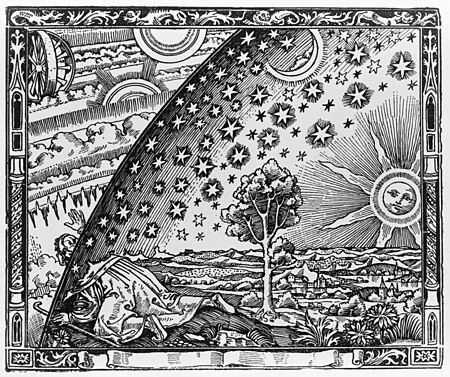
  • The known world is built inside a giant tabernacle and is flat enough that you can sail right off the edge, or pass beyond the misty boundaries of the world and meet the straining giants who hold up the sky. It also has curved horizons, Gygaxian 'slides to China', and a Hollow World (or two) deep within. Oh, and it's also the gathered cloak of a sleeping earth deity who will one day awaken and cast it away.

  • You can travel to the lands behind the winds, except for those times you can't because that would just be silly.

  • The moon is a bizarre desolation where the ground glows with sickly corpselight. What civilisation there is resides deep underground, leaving the surface to uncanny moonbeasts and marauding warbands of Whistling Selenites hungry for the fabled plunder of the mythic overworld. At the same time the moon is also the barque and the iconic weapon of a scholar godling who wards the world against raging star dragons (comets, at least in a certain light) and keeps the hungry, destructive sea goddess in her appointed place. Sometimes the moon's a grey desert sphere, sometimes it's a flat silver disc, other times it's a rocky crescent you can climb atop, and still others it's a twisted moon-faced thing leering and whispering baleful secrets from the night sky.

  • The sun is a giant ball of flaming gas, but it's also the golden palace of the solar divinity, as well as being some blonde dude in a chariot eternally chased by ravening wolves. You can sail the glowing curls of solar flares down to where spectral presences leap and cavort across the ever-burning plains, except when you can't.

  • The Void beyond, wherein lurk the alien intelligences that long to wipe away the fleshy infection of humanity, is Grubbian Wildspace, and a freezing gasping radiation-blasted vacuum, and a collection of isolated prison dimensions, and a colossal air-filled, hole-riddled dome through which starlight, rain and the occasional alchemist leak. Yog-Sothoth could explain, but he doesn't want to. :p

  • The realm of the gods? Over there, at the top of that mountain, or in that desert mirage. But also enthroned in their shining stellar palaces in the heavens (said stars also being distant suns, and leaky holes in the sky, and transfigured culture heroes), and in a subtle spiritual realm beyond the world we know, which happens to look a lot like fluffy cloudscapes. Oh, and the Powers that Be also have a tendency to hang out on distant planets and form looming doom-saying faces in nebulae. Gods are funny like that...
How and when does all this stuff change states? Mu. It doesn't. It's both/all at once/none of the above, as the game requires.

Object lessons I've taken from this:
  1. Whatever is more interesting to play is the right answer.
  2. It all works out so long as you throw a sack over logic's head and leave it tied up in a closet somewhere.
  3. Most players really don't care about internal consistency if inconsistency is more fun.

Pretty big talk for an game setting that's little more than a 25x15 hex map (and those numbers are hexes, not inches), a bunch of funhousey and thematically discordant dungeon levels, a sheaf of random tables, and some half-assed rules for what goes on in town between the looting sprees.

What can I say? Brass necks are really over-engineered 'round our way. ;)

Monday, 25 January 2010

Stealing Back the Dead

This latest mental eruction is in response to SuperNecro's recent post that argued the case for raise dead (and other such tamperings with life and death) being the exclusive preserve of decidedly dodgy necromancers. Although not entirely converted to the SuperNecro way I have to agree that raise read/resurrection as written in pretty much all iterations of D&D is, well, dull.

Raising the dead as written in the holy books of our hobby:

  1. PC goes "blarg! I's ded!"
  2. Mates drag body to nearest non-Evil temple (or cross the party scroll of de-deadification off the inventory list).
  3. Bright lights and choirs,
  4. *Ding* back to life,
  5. Our ersatz Lazarus - maybe a little woozy and a level short, but otherwise no worse for wear - is quickly back to the adventuring grind.

OK so far as it goes, but where's the fun in that? Ever since Save vs. Poison's post on Eldritch Weirdness reminded me that even low-horsepower magic can (should?) be freakish and uncanny I've been gnawed by the thought that raising the dead should mean more than an expended spell slot. Call me old-fashioned, but returning a soul from death is something noteworthy that marks everyone involved. Even in a world of magic and dragons breaching the bounds between the realms of life and death should be an adventure in itself.

Questing through the underworld to steal back a departed soul from the chthonic gods is one of the archetypal myths. If you're a top-notch mythic figure you travel through the underworld and rescue the dead. Isis and Kali did it; Orpheus tried and failed; Hercules succeeded (IIRC); Demeter hunted for Persephone; the Norse gods sent Hermod to try and redeem Baldur from Hel; Jesus raised Lazarus and harrowed Hell. The quest for the departed soul of the beloved is a cliché in itself.

Nearer to home, even the sometimes cheesy (oh yes it is!) Conan the Barbarian movie managed to make the ritual of returning a soul to the realm of the living exciting and a bit spooky. The lands beyond do not return new arrivals easily or willingly, even if they're tied down and swathed in more black cloth and weird facepaint than a goth.

So, what's the point of these latest wemblings?

Simple enough: IMG, as of now, no res spells. No raise dead. No resurrection. No 'dead, but playable' Ghostwalk antics. None of that. Heroic escapes and supervillain immortality, fine. But the old king gets to rest in peace; the death of the young is tragic; the death of a hero is a fitting end to their saga. Dead is dead, lest the final journey becomes a daily commute, and the bourn from which no man returns becomes just another poxy "save negates" status effect.

If, instead of just building a pyre, chanting elegies over the corpse and then squabbling over the loot of your departed swordbrother, if the players actually want bring them back, then they're going to have to work for it. As in 'turn the rightful order of the world on its head' work for it. That's a big ask, but that's exactly what heroes are for. They're going to have to do at least one of the following:

The Dreamquest
Looks like he's got himself lost in the bizarre shamanism afterlife. It's time for the the weird liminal stuff: spirit pacts with the otherworld, vision quests, lotus overdoses, induced comas, and suchlike heavy mojo.

Rescue Mission
The god of the dead holding your buddy against his will. Time to wander down to the underworld and get him back. Quixotic hunt through mystic underworlds full of hostile guardians, vengeful godlings, strange sights and death around every corner? Sounds a lot like the day job.

Favours Owed
Given sufficient incentive those weird formaldehyde-smelling priests of the gods of death may be able to help. Their especial position as the mediators between two worlds might allow them to beg the return of a soul from their masters' halls in extrordinary circumstances. At best this will be for a temporary purpose that benefits the temple (think quest spell), not a permanent arrangement.

Too Badass to Stay Dead
Unfinished business is a good excuse for allowing a well-loved but departed character to be in at the climax. Whether it be "Use the force Luke", or the shade of Druss at the Eltabar(?) Wall in Gemmel's Legend, or Conan's sunstroke-induced "Huh? Valeria?" moment in Conan the Barbarian, there's definite precedent for an unexplained 'one last encore' scene in the right circumstances. The character isn't back in the game permanently (no hero undead, thank you), but at least the player gets to sling dice with an old character one last time.

Clarkian Hoodoo
There might be odd thaumobiological cloning pods somewhere deep in the dungeons. These can function as resurrection lite, in that they're effectively save points for a character as he was at point X in his career. Getting to them in time to rescue the revived clone is another matter entirely. And don't ask what else the weird dungeontech is doing with their DNA, that information is proprietory and part of your NDA agreement. ;)

Pact with Strings
So you did a deal with some serious people. They did what you asked, but they haven't called to collect. Yet. And the more you think about it, the less cut-and-dried the deal you cut seems...

Put Back Together Wrong
The DM shouldn't necessarily monkey's paw everyone who makes a deal (Faustian, or otherwise) to come back from the dead, but having something come back with/instead of the expected returnee has a lot of precedent and can be fun. The newly revived might be a repository of mystic knowledge, suffer a peculiar yearning or strange dreams, be a focus of hostile/hungry spirits, or they might now be an unwitting open conduit to something other. hack/'s Raise Dead Too Boring? table is a gleefully vicious start here.

A quest to restore to life a departed comrade might seem to suddenly derail the current direction (or "arc", in buzzwordese) of our heroes' adventures, but that's fine in my book. Having someone who was a much-loved fixture in your life taken from you untimely causes massive changes in outlook and direction. What better reason to put the search for gold, glory, fame, booze, chicks and more gold on hold for a while than getting the gang back together?

"Let down the curtain, the farce is over." -- last words of Rabelais

Sunday, 24 January 2010

Zombies? In my Vaults?

A brief, and largely pointless, paean to the joy of incremental emergent complexity (aka, the power of "How did that get there?").

Ideas are odd. They have a tendency to grow beyond their bounds if you let them. You have to be careful of the things, or they'll grow, ramify and insinuate themselves like briers (kudzu to yon Yankee devils).

Consider if you will the example of the cabal of Masked Sleepers on the 1st level of the Vaults. Now, I didn't consciously write these chancers into the Vaults, they just emerged from a random idea which was worked on by the needs of the game and the internal logic of the place.

The Masked Sleepers started out as a quick, lazy reference on a wandering monster table:

"19-20. Masked Sleepers - treat as zombies".

Simple enough. Just your bog standard zombies with a palette swap and Mycenean death masks (I like Time Bandits: who doesn't?), designed to fool the players into not immediately making the obvious "Brains!" ===> *yawn* "Turn undead" connection. No change in stats, merely a fluff modification.

A little thought and some judicious idea theft later (In Nomine: the ironic Hell of Nybbas, a place in which each sinner focuses obsessively on a fetish object to the exclusion of all else), and the Masked Sleepers started to become something more. The image of eight gently rocking Sleepers standing in a fixated circle around a glowing shewstone in an otherwise darkened room is one of the more memorable images of recent sessions.

"What are they doing?"
"Humming."
"Not attacking?"
"No, just humming. And swaying a little. They're not even looking at you..."

With the masked sleepers established their presence gradually expanded to touch other, already established, elements of the Vaults. The otherwise randomly parachuted-in Oneiromantic Hall ("Glass walls swirl with multi-coloured smoke. Stagnant pool surrounded by benches in centre of room. Elaborate curtained beds in wall recesses. Anyone resting in a bed has 50% chance of dreams cryptic but true") on the first level of the Vaults became the means of their creation ("Dying person placed in bed arises as Sleeper 1d6 turns after death").

Once they'd wormed their way in there, there was no stopping the gradual encroachment of the blank-eyed mumblers (not related, but fun). I ended up having to write a whole new section of the Vaults (thank goodness for the One Page Dungeon template, and the Empty Room Principle). The flaying rooms, skin frames and ossuaries of the Masked Sleepers gradually got linked in with the tribes of scavenging humanoids (tologs, chokers, goblins) on level 1, and with the Gnoll/Ghoul tribal areas on level 2.

Likewise the half-dozen "I dunno" blank rooms that slowly morphed into the Oneirist's Sanctum, and the - as yet unexplored while I figure out a fun twist - Carceri of the Unreconciled sub-level. Entirely without conscious volition on my part, a simple mob of slow-treading lost souls became a mini-motif of the upper Vaults in their own right. Not bad for a throwaway comment.

That said, I still haven't done anything with the Rook Seers I mentioned in passing, ooh, yonks ago now...

This is the north. We do what we like.


Durham, really ruled by priest-kings

Funny thing. I always intended the Wilds of Nagoh (the overland area around the Vaults) to be a dry and desolate region, such as you might see in spaghetti westerns or in cheesy 80s fantasy films like Conan the Barbarian, Beastmaster, etc. Despite my desired intent it seems to have gradually morphed into a fantasy version of the north of England; specifically the kind of stark, sunless terrain you might see in films like Dragonslayer or Eric the Viking. Oh well. Thur go the proud galleys, reeking temple cities, and dusty Ozymandian statues (at least for now).

Instead of scrub-covered SoCal hills, or the endless high plains and Monument Valleys of John Ford westerns, or even the bizarre fungus forests and amoebic seas of Carcosa, Athanor, Algol, or lost, lamented Thool, I seem to have ended up with a default scenery of wind-whipped moorlands, hills and bogs.

In my pointy little bullet head adventurers traverse a land of skies as grey as Grimnir's eye, rich with layered cloudscapes and long twilights; a land of dour locals tending hardy livestock in the shadow of smoke-blackened peel towers and lowering crag-top fortresses; a land of bright gold and ancient bones turned up by the harrow's iron bite. Brontë country, had the Brontës but followed a vocation as cold-eyed killers.

(note to self: herd of Brontësaurs half-seen in the mists, totally works)

Sure, there are places of breath-taking beauty and prodigious fertility; veritable edens abounding in all good things, and all the more keenly contested for it. But the general impression whenever I think of the Wilds of Nagoh seems to be of a place where the weather and terrain - let alone the inhabitants - will capriciously shift in mood and kill you as soon as look at you.

What can I say? Maybe it's my upbringing in the littoral areas of the North Sea, but I've always had an unconscious prejudice about exposure being a swifter and surer killer than lack of water. It appears that, for all the mythology of dehydration that runs through so much adventure literature, the widow-making nor'easter, the rain-borne blight, and the icy breath of the loping wolf have a stronger hold on my imagination than the fate of Cambyses lost army or the ill-fated Donner expedition.

That might be a suitable post for another day: a quick and simple death by exposure rule, perhaps in the style of James Raggi's embryonic (embyronic?) LotFP Wierd Fantasy RPG. Then again, I imagine adventurers in the wind-swept wilds have sense enough to pack warm clothes. No sense in getting bogged down in minutiae that doesn't advance the game... (Preferences Y/N re. this? Please comment.)

Apropos of nothing, here are some Wilds of Nagoh bullshots for you (please excuse the wonky formatting, blogger isn't playing nice for me):


High Force falls


Some big wall or other, I dunno.


Rocks, a traditional staple food of northerners


Bamburgh Castle


Smailholm Tower (an example of a Peel Tower)

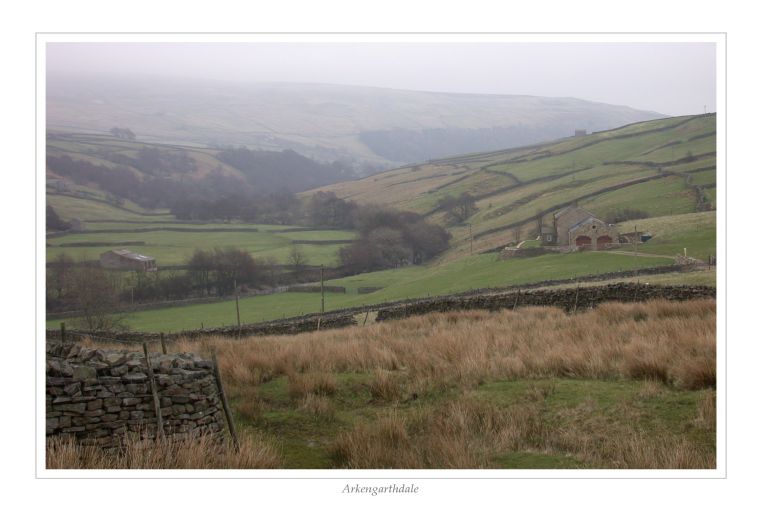
Arkengarthdale, probably the most Tolkienian place name ever!

Write what you know, I suppose. At least I get to use all that juicy Danelaw/Border Reiver local colour. A land infused with the aroma of Mimir's brew, rather than Bacchus'. Pure Tolkien territory, or possibly Gemmell country. Yep. That smacks of high adventure to me.

PS: all this aside, my starting town of Adburg is still a mash-up of Deadwood, Lankhmar and diamond rush-era Kimberley.
Related Posts Plugin for WordPress, Blogger...