Showing posts with label send help or cyanide pills. Show all posts

Monday, 25 February 2013

Lets Read Mythus pt 23

This week in Let's Read the Garynomicon we'll look at the sample Dweomercraeft (wizardin') and Priestcraeft (godbotherin') Castings on offer to players who foolishly assumed that Dangerous Journeys: Mythus was a complete game in itself.

Reading scores of Mythus spells castings descriptions: it'll do that to ya.


For those playing along at home we're starting on page 278 of the big brown book. Expect the usual acronyms, neologisms, and wordiness, and - for this week only - the introduction of an additional rule: drink once each time you've seen this somewhere before.


Sample Castings

Casting Grades (aka Spell Level in D&D-ese) I-V, 3-5 example castings per level.

Casting time is included in the name of the spell. This wouldn't be so annoying except that the text explaining required casting time isn't even listed in this chapter. The casting times are all the way back in the Mythus Prime section on p22! "Put magickal casting times in the magic chapter? Oh what a card you are my lad..." For the record:

Mythus Casting Times
Eyebite - instantaneous
Charm - 1 CT (3 seconds)
Cantrip - 5 CT
Spell - 1 BT (30 seconds)
Formula - 5 BT
Ritual - 1+ AT (5 minutes)

Oh, and the E/F/M notation that precedes the descriptive text of each spell. If you check Mythus Magick you discover it means "Effect, Force, Material". So "spell effect" in any game that got edited to make sense to the people of Earth.

Dweomercraeft I

Armor, Physical Cantrip
Anti-kinetic energy effect. Useless against Mental or Spirit attacks.
Costs the base 20 Heka + 1 per point of protection desired to to a max = Caster's Mental TRAIT. Lasts 50 minutes, or until destroyed.
Basically a fiddly combination of the D&D spells mage armour and stoneskin. Sucks.

Detect Heka Spell
*ping* presence, type, source and strength of Heka in a 1 Rod radius.
Detect magic, innit.

Reflections Spell
Basic scrying spell. Requires a reflective surface.
Spy on someone for 5 mins per 10 STEEP.
Difficulty depends on how far away they are and how well you know them.
Lead, stone and various dweomers block your tele-perving.

Trigger Effect Formula
Creates trigger for other magical effects. Used in conjunction with another casting. Description is gobbledegook.
"Whaaaa-?"

Remember the nightmare of nested effects that was 3E contingency? All that for 20 Heka. *shudder*

Wickaflame Charm
Spark 1 or more small non-magical flames in existing tinder. Range is 1 Rod per 10 STEEP.
Probably meant to be a "wave hands, lamps light" spell; actually an arsonist's charter.

Dweomercraeft II

Armor, Mental Cantrip
Anti-brainfondling defence.
35 Heka + 1 per point of Mental defence. Max = Mental TRAIT if caster is Full Practitioner Master Race, MRCap if Partial Practitioner Untermensch.
Otherwise as Armour, Physical Cantrip above.

Forcedart Charm
Creates a single "dart-sized missile of golden energy".
Dart does 2d6+1 per 10 STEEP Physical Impact damage at a range of up to 1 chain per 10 STEEP.
Hits unerringly, ignores physical armour. Muggles cri moar plz.
A magical missile you say? How unprecedented.

Heka Trap Spell
Magic landmine on on object that endures until triggered.
Say the wizard's chosen safe word or take damage = 3d6(+caster's MRCap+any extra he buys at 1:1 Heka). Damage is any non-continuing type.
Boring "gotcha!" version of a guards and wards effect.

Ritual of the Heart Ritual
Expend a week, Heka equal to 2xSpirit TRAIT and make a DR "Hard" Dweomercraeft roll to bind a 'mascot' or totem item.
Why would you want to do this? Refer to Mythus Magick for more.
This casting is one you may find familiar (pun intended, for once).

Dweomercraeft III

Armor, Spiritual Casting
50 Heka +1 per point of Spirit defence.
Doesn't prevent attempts to forge Spiritual Links, just grants ablative soul padding.
Otherwise as Armor, Mental casting.

Avoid Heka Attack Ritual
Grants an Avoidance roll (aka Saving Throw) against any one Heka-powered effect.
Base chance to avoid is the average of your Physical Speed scores + 10% of you STEEP in the skill used to create the effect. This chanced is then modified by arbitrary GM-fiat difficulty levels.
Don't waste your Heka.

Heka Darts Charm
Creates multiple darts (1 per 10 STEEP), each doing 1d6+2 Physical Piercing damage at a range of 1 yard/STEEP. Darts Strike unerringly and ignore physical armour.
Several magical missiles, eh? The innovation! It burns!!!

Implant Spell
Photographic memory of written text for 24 hours. Caster can duplicate anything memorized for the duration of the casting.
Semi-interesting, I might use that in a Classic game. Actual usefulness, is that you? *gluk gluk*

Dweomercraeft IV

Armor, Heka Cantrip
75 Heka +1 per point of anti-Heka armour.
Otherwise as Armor, Mental Casting.

Barrier Formula
Magical electric fence in 1 foot radius/STEEP.
Lasts 5 minutes per STEEP +5 mins per Heka spent.
Barrier causes 1d3+1 damage to any creature touching it. Physical beings take Physical damage, otherworldly beings and ghosts take Mental or Spirit damage.
A creature damaged must save or, sorry, wrong game make a DR "Hard" check against its PNPow (or MRPow, or SSPow *gluk gluk*): success = pass through barrier taking an additional 1d6+1 damage, fail = recoil.
Successive tests to push through the barrier are at DR "Moderate" for 2nd attempt, "Easy" for the 3rd.
Non-absolute protection from evil spell. May be of interest for your Classic game if you dislike the existing spell.

Mask Heka Spell
Renders the Heka aura of an object or area undetectable.
Up to 1 rod diameter per 10 STEEP. Permanent until dispelled.
Masking an area from Supernatural and Entital Heka requires additional castings.

Dweomercraeft V

Cloud of Magick Spell
Heka smoke bomb.
Lasts 5 minutes per 10 STEEP and makes everything in a 1 foot diameter per STEEP *ping* equally when detected for Heka.

Heka Bolt Charm
Straight line burst of Heka hitting every target in a line out to 1 furlong.
Does 5d6 Physical Piercing damage +1d6 per 10 Heka to a maximum of 10d6.
Hits unerringly. Ignores physical armour.
Wizard HAET queueing!

Invisible Alert Formula
Creates an alarm bubble up to STEEP feet in diameter.
Lasts 1 AT per STEEP + 1 AT per Heka spent.
Any physical thing ("...including gaseous liquid...") entering this zone of misanthropy alerts caster to "...direction of passage, point of breach, and who or what passed into or out of the sphere."
Might be useful for paranoid sleeping wizard, except: nocturnal animals exist, that is all.

Priestcraeft, General
Rites and rituals which affect only those who follow a particular ethos (white hat, black hat, one of Mythus' three shades of ambiguous hat), pantheon or religion.

Priestcraeft General I
Rites Ritual
Seven quasi-sacramental rites:
  • Birth
  • Death
  • Marriage
  • Separation/Divorce
  • Acceptance of Ethos, Pantheon and Deity
  • Service
  • Penitence
Regular participation in these rites is required to keep in good standing with one's religion.
Basically the clerical ceremony spell from Unearthed Arcana.

Priestcraeft General II
Blessing, Minor, Spell
One-off +/-5 bonus to next die roll.
May only be cast on person who follows the same pantheon.
Yeah, the bless spell for a percentile system. It's even reversible.

Priestcraeft General III
Consecration Formula
Hallows a sacramental object or area so that any sacrilegious action or profane touch causes 1d3 Spirit damage to anyone not of the ethos. Damage from multiple acts of desecration stack.
A direct damage equivalent to the d20 SRD hallow spell?

Priestcraeft General IV
Blessing, Major Ritual
Negates opposing curses resulting from Grade I or II Castings, or grants +/-10 bonus to one die roll. Can also be used for non-mechanical social effect (blessing crops, animals, ships, etc.) if you want to burn Heka for the sake of seeing the peasants smile.
Additional subjects can be blessed in the face for 5 Heka each.

Priestcraeft General V
Guidance Spell
Allows the caster to bother Upstairs for advice, or to give good counsel to others in accordance with the tenets of their ethos, pantheon and religion. Anyone following the advice enjoys the benefit of the Blessing, Minor Casting.
A classic 'clue me' spell, with a minor mechanical benefit. Is a clue worth +65 Heka to you?

Priestcraft, Basic
Common spells. Less 'pastoral care' than General Castings.

Priestcraeft Basic I

Lightsee Charm
Causes 1 object per 10 STEEP to glow like a candle for 5 minutes per STEEP.
Renders books readable, dark passages navigable, etc.
Light is visible from 100 yards in darkness.
A less torch-negating light spell.

Prayer Cantrip
Increases the STEEP of one of the caster's K/S Areas by 10 for about 2 minutes.
Can be used to enhance caster's own Priestcraeft K/S for cheesy synergy shenanigans.
Half the Casting description is spent advising the GM to punish uses of this spell which are contrary to the ethos of the caster.
Interesting meta-magic effect, not sure if it would be back compatible to Classic games.

Produce Meal Ritual
Produces one typical priest's meal (as appropriate for the religion) per 10 STEEP.
So: 20 Heka/day, no expenditure on rations.

Pronouncement Spell
Caster spends 1 Battle Turn (30 seconds) pulling rank and proclaiming [preferred flavour of god] is on our side. The player is required to state exactly how 'we're right, they're wrong' today.
All within 1 chain radius enjoy/suffer a half-strength version of the DR modification granted by Joss in their support/opposition to the stated fact.
An actual worked example would have been helpful here.
Pronouncement can also compel agreement and obedience from any co-religionist with a lower STEEP than the caster. This lasts 1 AT per STEEP.
A supercharged version of command affecting a 40yd diameter? Not bad for 20 Heka.

Smokecloud Formula
Generates stable, non-moving incense smoke (complete with caster-selected scent) in 1 foot radius per STEEP.
The smoke lasts 1 AT per 10 STEEP and reduces visibility to 6 feet.
Fog cloud, sponsored by AirWick?

Priestcraeft Basic II

Healing, Minor Formula
Restores Physical damage: 2d3 damage per 10 STEEP of the caster.
Touch range, instantaneous effect.
CLW. That is all.

Heal Mental Damage Ritual
Restores Mental damage to someone other than the caster: 1d6 damage per 10 STEEP of the caster.
Touch range, instantaneous effect.

Meditate Spell
Allows meditating casters in a 1 square rod/10 STEEP area to gain the benefits of an hour of meditation in 5 minutes.
D&D4E style short rests: done first by EGG.

Rightcourse Cantrip
Divinatory casting which indicates whether a given course of action will result in transgressions against the ethos of the caster.
No idea why this has an area of effect, duration and range.
Spend 35 Heka to play "Mother may I" as an in-game effect? Not to all tastes. Pass.

Priestcraeft Basic III

Bounds of Action Charm
Restricts a physical target to a 1 rod radius area centred on their current location for 1AT per 10 STEEP.
There's a paragraph of rules about breaking free of this effect, but its limited to characters with a PMPow (aka Str) of 30+.
This is an interesting, pulpy variation on the old standby of hold person.

Enhance Spiritual Power Formula
Boosts the caster's Spiritual Mental Power and Spiritual Psychic Power to the maximum Capacity possible for each Attribute for a duration of 1AT/10 STEEP.
If no increase is possible then both Attributes are enhanced by +1 each instead.
Resembles nothing so much as the stat enhancing spells of the SRD.

Enlightenment Ritual
The player gets to ask the GM one "Yes/No" question about past events or contemplated activites, which must be answered truthfully.
Another "clue me" spell, one with echoes of the contact other plane Classic D&D spell.

Heka Defences Cantrip
Grants the target 1d6(+caster's SMCap if a Full Practitioner, SMPow only is Partial Practitioner) protection which wards against all damage types.
Otherwise similar to the Physical, Mental or Spirit Armor cantrips.

Priestcraeft Basic IV

Protection from Lightnings Spell
Generates a magical Faraday cage of 1 yard diameter/10 STEEP centred on the caster.
The spell dissipates _dice_ of electrical damage equal to the caster's STEEP (1/2 STEEP if a Partial Practitioner).
A nice counter-balance to the hair-raising (no pun intended) power of electricity in Advanced Mythus.

Sanctification Ritual
Can either double the damage inflicted by the Consecration Formula (above), or can be used to enhance a single consecrated object (for example, the priest's holy symbol). For each 100 Heka expended the sanctified object will cause 1d3 Mental and Spiritual damage on sight, 2d3 Physical damage upon touch, to any being of an opposed ethos within a 1 rod radius.
An interesting variation on clerical turning. Probably a bit number-crunchy for players of Classic games though.

Wound, Spiritual Charm
Causes Spirit damage of 1d6(+1d6 per 10 extra Heka, max added dice = 1/10th caster's STEEP) to one target within yards = STEEP.

Priestcraeft Basic V

Heal the Soul Spell
Heals Spirit damage: 1d6 per 10 STEEP (1d3 per 10 STEEP if Partial Practitioner).
The target must be of the same ethos as the caster.

Thunderbolt Cantrip
Calls a lightning bolt from the blue within 1 yard/STEEP.
This causes 5d3(x1d6 Exposure roll) Electrical Physical damage to the primary target and 3d3(x1d3) to all subjects within a 1 rod radius.
The accompanying thunder startles all creatures with a Mental Reasoning Power (aka Intelligence) of 10 or less; startled creatures run in panic for 1d3 Critical Turns (or stampede if animals).
A numerically fiddly version of D&D's call lightning spell with a nice panic!!! fillip.

Word of Command Charm
Causes 1 subject(+1/10 STEEP) within earshot to obey a single word command for the next CT.
This is the Classic D&D command spell, right down to the proviso that "Die!" results in auditors only appearing dead for one round CT.

-----

If you're at all familiar with any of the spell lists from Classic D&D your deja vu will be going nuts by now (feel free to drink until it abates). The Castings on offer indicate a typically Gygaxian folkloric implied setting; one where wizards lurk over scrying pools, sling various sizes and shades of burning arcane arrow, and leave cursed objects lying around, while priests alternately bless their flock and call high-amperage arcs from the sky onto the heads of the unbelievers, etc.

Some of the spell variations from the more familiar D&D norms are interesting (and the similarities are certainly not worth a lawsuit); it's just a shame the spell names are so, soooooooooooo tin-eared. Seriously, "Ritual of the Heart Ritual" is only the stand out offender in a full and busy field: "Summon Familiar" is quicker to say, conveys more information, and doesn't repeat itself in an awkward Dept of Redundancy Dept way. Once again Advanced Mythus reminds us that editing is not optional.

In the Small Mercies column of the ledger: at least the bad joke that was material components didn't make it into Advanced Mythus.

Next Time: Apotropaism, Astrology, Herbalism and Mysticism Castings.

Pic Source: teh intawubz

Monday, 18 February 2013

Lets Read Mythus pt22

Today's subject for dissection in the ongoing Let's Read Mythus debacle is Chapter 13: Heka and Magick. Please be warned that this post may contain higher than recommended levels of gibberish and is likely to induce second-hand outbreaks of:


The customary rules apply, with an additional fillip that one should also drink every time the reader is prompted to "buy our other book for full details of this". Because nothing builds bonhomie like a naked cash-grab.


Heka and Magick is a self-confessed crippleware chapter comprising pp276-294 of the Dangly Jibblets: Minkdust rulebook. The introductory paragraph admits that the Castings which follow are no more than "...a sample listing of basic Castings, sufficient to get your campaign off the ground." Where can you get the full skinny on casting in Mythus? Well, if you said in the Mythus Magick book (sold separately), then reward yourself with a drink.

So what do we actually get for our money? Two pages of poorly cross-referenced rules/notes text and a bunch of what anyone not being trollsued out of the industry by Lorraine Williams would just call 'spell descriptions'. Oh, and a new page header: a still life of a squished wizard amid the paraphernalia of his trade.

Insert your own "Caryatid squashed by the weight of verbiage" gag here


After a paragraph of shilling for the patch to this broke-ass 400-pages of half-a-game we jump straight into the subject of Heka (pron. HEE-ka). Two paragraphs rehash what we've already been told about half-a-dozen times now: that Heka works like magic electricity; that 'impure' versions of Heka -- variously called Baraka, Orgone or Mana (Mmmmm, thesaurus abuse! *gluk*) -- exist in worlds not as dominated by the Pure Spellcaster Master Race as is Aerth; that even unintelligent creatures can use Heka instinctively; and that Pure Heka is of three sorts: Positive (from the higher places and spheres), Negative (from the Other Place), and Mixed.

Yeah. So far this feels like what it is: a précis of something longer, more involved, and baroquely over-complicated.

Next up: Demographics of Heka. A paragraph spent explaining the prevelance of Heka-slingers in the populace. The figures boil down to 1-in-100 for people able to cast at all, with various sub-breakdowns for who can use what type of Heka; who draws their Heka from one, two or three Attributes; and who gets to be a touched-by-the-dice-gods Full Caster. This is dull stuff and probably billonga setting book, not rules chapter. A more practical use for this section would have been putting the bloody shifty, elusive rules for determining Full Caster-ness here.

Next is half-a-column on Types and Sources of Heka Energy, which starts with a seemingly unrelated paragraph about the nine Grades of Casting Power, and an aside that certain special Grade X castings exist and that these are on a par with Supernatural Castings of Grade I. Nope, not a clue. If you want to know more: cough up for Mythus Magick.

There's also a rehash of the three types of Heka (Preturnatural, Supernatural and Entital), which are entirely different from the three types introduced above. If you recall from way-back-when in LRM pt3 Supernatural and Entital are 1:10 and 1:100 Mega-Damage Heka.

And finally a list of things you can squeeze for Heka in the Mythus universe:


Sources 1-5 are pretty much what you'd expect: push button, recieve mana. But source 6 "Entital vegetable substances" confuses the bejaysus out of me. WTH is an Entital vegetable? Some form of otherworldly arcanocabbage? The freshly-peeled god-corpse of Nazi-fighting root veg Dr Carrot? No clue given. Oh look, they do give us a helpful clue as to which book to refer to...

After that particular unintended Mythusian mindscrew we're off again to half a page + a couple of big-ass tables regarding Heka from K/S Areas. This begins with the word "Imprimus" and goes downhill from there with a load of waffle on who can generate Heka from where, how fast, how much, and from which skills. Most of this is semi-familiar from other chapters, but I lack the will (or remaining SAN) to check if there are contradictions between blocks of text.

One thing that jumps out is a table that would have been useful, oh say, back in the damn skills chapter! To whit:


Idiot-savant version of a unified Heka Skills table I ranted about back here.

Now, so far as it goes that is a not-entirely-useless table. At least now -- nigh-on 180 pages after it might have first come in handy -- a player can see at a glance which K/S Areas grant Heka, how much and from what character stats. That might almost be called useful, at least for the purpose of buzz maintenance. *gluk*

And then you realise that thick block of text over there on the right is footnotes.

Yes, the true horror of this brute of a table only really bursts forth when you start digging into the notes. Most of the them either waffle on where a single terse sentence would suffice, or outright re-iterate things we were told back in the relevant skill descriptions. In the latter case "See description, pXXX" is perfectly sufficient.

Call me a grouchy infographics snob, but a case could be made that if footnotes take up more space than the table they accompany, then the way you are attempting to present your information is objectively not right. A first draft is supposed to look like a sharp-cornered, burr-edged, over-complex mess; a professionally designed tool for use in play is not.

A final squeezed-in section on Regenerating Personal Heka tells you how much Heka you get back per hour per skill from your K/S Areas, and also how much you gain back from Attributes, Categories and Traits. It is four paragraphs of word salad that looks like English at first glance only. The accompanying table is especially sad-making.

"Prithee good sir. Art thou shittin' me?!"
"Nay sir, I be not. Now draw forth thy slide-rule and get thee to reckoning."

Yes, excellent. No foreseeable problems with player rebellion here. An excellent response to the oft-heard lament that the AD&D Psionics rules were insufficiently fiddly.

And that's your lot on the subtle wonders and intricacies of Heka and Magick in Mythus.

Oh, wait. You want the mechanics for actually using Castings in play? In the Heka and Magick chapter? How precious. How quaint. Those are way back in the earlier Combat chapter, on p218. Which in turn requires reference to the Core Game Systems (chapter 11) and the K/S Area descriptions in chapter 10.

Hope you enjoy the delicious breezes kicked up by repeated thumbing through big fat books, coz you're going to be doing a lot of that. There's not even a single appearance of That Damn Table in the one place where it might have actually have been of some utility. Useless!

Sample Castings
After the seemingly unedited logorrhoeaic HØRF! that opened the chapter we turn with -- probably misplaced -- relief to the spell Casting descriptions which comprise pp278-294 of this slithey tome.

Sample Castings of levels I-V (Roman numeras as original) are given for the schools of Dweomercraft (wizarding), Priestcraeft (clericing), Apotropaism, Astronomy, Herbalism, and Mysticism, at a rate of several per level, which is nice.

"But Chris, you gormless knock-kneed bogmonkey," I hear you cry "Where are all the other types of magickqkck which the many, many K/S Areas of Mythus use? I count a mere six lists there."

Why yes, gentle reader. Although puffing itself as a game that presents nine, sorry, IX levels of magic in nigh-on a score of schools and traditions, the core Mythus book presents only samples of six schools, and only up to level V. As for the rest, they are found in a lost tome of eldritch lore entitled... yes, I think you can see where this is going... *gluk*

Although the vastly superior Imperial measures are used in all instances (I kid you not, there are ranges given in rods, chains and leagues in there!), there are a couple of gross procedural niggles even before getting into individual spell descriptions. The unexplained acronyms are annoying ("WTF is E/F/M? Any corresponding entry in the Glossary? Of course not!), and repeated inclusion of BHC (Base Heka Cost) that remain constant across all schools and levels but are not integrated into a single simple table is just an offence against good design.

Base Heka Cost -- Casting Grade
20 -- I
35 -- II
50 -- III
75 -- IV
100 -- V

That there: not flippin' rocket surgery!

Get past the Mythusisms of the layout and descriptions, and many of the Castings will look familiar to role-playing veterans, albeit with any sense of wonder and magic pummelled out of them by a leaden prose style. For example:

"Zzzzzzzzz."

Next Time: We grind the individual Casting descriptions for anything that might actually be of use in a Classic D&D game. It will be as glorious, life-affirming and full of colourful pageantry as Passchendaele. Oh, wait. That's not what I meant at all...


Pic Sources: the Dangerous Journeys: Mythus rulebook, the hark a vagrant webcomic, teh intawubz.

Monday, 2 July 2012

Lets Read Mythus pt19

Welcome again to Let's Read Mythus, our weekly trawl through the Gary Gygax's post D&D masterwork. Today we trudge into the murderous mess that is the Advanced Mythus Physical Combat rules, which may or may not be of usable salvage value to players of other games.


Physical Combat, Lethal


Week three of Combat, and we finally get to the crux of the matter: thwacking dudes with swords. And, no, that's not just me being a bloodthirsty lowbrow bogmonkey; we have it on good authority from the pen of the master his own bad self:

One of us. One of us. One of us.

One nice short paragraph saying that Lethal Combat is dangerous (No, really?) and assuring us that "Note that while these rules may seem complicated, once you get used to them they're quite easy. They are designed to simulate reality and the actual suspense which exists in combat." Ok. So the confusion, tears, pain and screaming were actually a desired outcome borne of careful attention to verisimilitude, and not just my reflexive horrified reaction.

Front and centre attention is drawn to the all-important sidebar, to which anyone daring this section will probably want to cling to like a drowning man snatching at a life ring:

This is your (war)god now!

Pages 223-230 are all just footnotes to this.

The main thing to note is that, unlike every other form of combat in Advanced Mythus, Lethal Physical Combat offers absolutely no option to do anything other than hit someone. There's no option of attacking to cripple, or blind, or disarm, or anything else. Eight pages of mechanics for hitting and hitting back. And that's it.

Oh, I tell a lie. You can parry someone else's attempt to hit you. Big whoop!

Notable new jargon:

Basic Attack Chance (BAC) -- weapon skill STEEP + modifiers for high Perception and quick reflexes
Final Attack Chance (FAC) -- This is your BAC after all modifiers; what you actually roll the die against.

Weapon Information


Pages 223-225 are full of information, tables and worked examples explaining how to determine attacks and damage with a particular weapon. It starts thus:


And, like some sort of aspie Terminator, absolutely does not stop until the end of p225. There is a lot of info here, all divided up into sub-sections corresponding to the numbered points above:

BAC
This is STEEP + Weapon Points + Bonus for Physical Perception. Each of these gets some defining blurb.

STEEP we know. That's your skill level with the weapon in question derived from the relevant Combat (HTH, Lethal, or Hand Weapon, or Hand Weapon, Missile) K/S Area sub-area. Mmmm, delicious jargon. (*gluk gluk*)

Weapon Points are a novelty. These are a seemingly ass-pulled number that a particular type of weapon adds to your BAC. I'm a bit vague on what Weapon Points represent: possibly some abstraction of reach and handiness? All weapon, except HTH, Lethal weapons like nunchaku and tai-fu, have Weapon Points. Why? No idea. Magic weapons have bonus Weapon Points over and above the norm for their type.

Bonus for Physical Perception are granted for high stats according to the following table:


Just for completeness, we're also told how to work out BAC for characters who lack the correct K/S sub-area to correctly wield their chosen stab-toy. Half-trained klutz BAC is Weapon Points + 1/2 the relevant general Combat skill (HTH Lethal, Melee or Missile). Total combat virgin BAC (for those with no relevant weapon skill) = Weapon Points only. Enjoy your sudden, messy death.

Attacks per Round
Varies by type of weapon and by skill with weapon. We're helpfully referred back to the skill descriptions, and forward to the weapon tables later in the Combat chapter. Try to enjoy the breeze as the pages flap back and forth during the orgy of cross-referencing this section requires.

Damage
A couple of tables giving bonuses to Physical damage. These are just clarifications of simple rules:
  • High STEEP damage bonus is +1 per 5 points of skill over 40. At 71+ this increase to +2 per 5 points. So +4 at 56-60, +5 at 61-65, +10 at 76-80, etc.
  • High PMPow (aka STR) damage bonus is +1 per point over 12. So +2 at 14, +3 at 15, etc.
 There is also a table of bonus damage per die for being extra HUEG:


The bonus damage per die is a nice touch not often seen outside some of the more obscure sub-rules in AD&D, but I'm not sure how often this table will actually see use. Remember that the implicit setting of the Advanced Mythus game is a rigidly humanocentric place where even the bog standard fantasy races are strictly optional: something like ogre or ice giant is definitely not a default character type in this game.

A list of damage types (previously seen in the Heka-Based Attacks section) make a re-appearance for the sake of completeness. The damage types follow the previously defined rules.

Reach or Range
One paragraph. Range for claws and martial arts is 1 yard, and longer weapons have a longer reach (given on the weapon tables). Missile weapons have the best range. Waste of a paragraph, you might as well have just written "refer to weapons tables" and been done with.

Speed Factor
Again, one paragraph. Again, could have just been a "refer to weapons tables" reference. Martial arts attacks and weapons = 3. All other weapons consult the weapon tables. Echoes of AD&D are echo-ey.

Parrying
Durability of parrying weapons, etc. Actual rules for blocking incoming objects with other objects are given elsewhere, this is just commentary on filling out your weapon description.


Shields modify the damage capacity for their quality and composition according to the last column of this table. So an average spear will be (Average quality, Combo composition) 8/20, while an average rimmed shield will be 8/30. Exactly what these numbers mean is explained later in the Combat chapter, under Parrying. Try to restrain your excitement.

Magazine
What's left in your cho-ko-nu or quiver? You must know. It is important! Yes, of course Accountancy Mythus tracks every last arrow, bolt, and sling bullet. Did you honestly expect anything different?

Congratulations. You've now filled out the relevant stats for one weapon. Now go back and do it again for all your other jabbification devices. It shouldn't take that long. It's not like you intended to spend any time role-playing or anything...

So far I'm strongly reminded of the 1d4chan entry for RoleMaster? ("An ancient classic from the Dawn Times. If you picked up this game in 1980 and started making a character immediately, then you should be almost ready to play this Friday.") Most of this stuff is just a waste of words. Two-and-a-half pages to define the qualities and characteristics of your weapon when the basic rules for using the damn thing only take a half-page sidebar is just sheer pandering to the 'no common sense' element of the readership.

Final Attack Chance (FAC)


As those who bothered to read the Physical Combat, Lethal summary boxout will already know, FAC is what you actually roll against to hit. It's calculated as the sum of your BAC +/- the scads of modifiers detailed over pages 226-227. Simple enough, right?

Modifiers to BAC differ from a lot of difficulty modifiers in Advanced Mythus in that they are linear modifiers (+/-n), rather than adjustments to Difficulty Rating multipliers. I have no idea why this exceptionalism exists, and there's nothing in the text to enlighten me. Any suggestion of a savage Mythus playtester revolt in favour of traditional percentile modifiers is naught but wildest speculation on my part. ;)


Advanced Mythus playtesters, circa 1991

Some modifiers only apply to ranged attacks; others apply to all Lethal attacks. "Hand weapons, martial arts and natural attacks use only the Attacker's Movement, Target's Movement and Position tables." This is explained in the text, rather than being marked up on the page-spanning table of modifiers where it might actually be helpful. I've taken the liberty of correcting the oversight.

Sooooo many modifiers. Soooooo much scope for clarification and simplification.

Dodging in Advanced Mythus is subsumed in this (sub-)section and takes the form of a mathematically insignificant 'always-on' modifier to FAC. Dodging bonus is available only to people with crazy-good reflexes, and is usable only when wearing light armour.


Runequest fans will be feeling some more deju vu about now.

The situation isn't as bad as it looks at first glance given that Advanced Mythus HP's Attributes are generated on 2d6+8 rather than the more traditional 3d6. So anyone with better than average (for an HP) reflexes will get at least some dodge bonus, however insignificant. And boy are dodge bonuses insignificant: +1-2% for dodging when the act of walking grants a -5% modifier is just what can reasonably be called a b*llsh*t bonus.

So that's yet another grudging, pixel-bitching, mechanically inconsequential stat modifier to keep track of. Which - I'm sure we can all agree - is a hallmark of good game design.

A couple of additional notes extracted from the dense text on FAC:
  • BAC can never be reduced to less than 10% of initial score by negative modifiers.
  • FAC is usually a DR "Hard" (x1) skill check. Judging from the worked example offered expending Joss is (seemingly) the only thing that modifies this DR, rather than playing with the percentiles.
  • By default all of a character's attacks are taken on the same initiative score.
This section has lots of wordiness and some p*ss-poor organisation of info. I'd have done it all very differently. Small mercy: at least the GDW layout chimps managed to get all FAC stuff onto one two-page spread.

Special Hits/Special Misses


Crappy layout orphans the Crits/Fumbles text from its accompanying table. The Lethal Combat Crit/Fumble rules are pretty much a rehash of the Non-Lethal ones we've already looked at:

Crit = maximum possible damage (*snore*)
Minimal Hit* = minimum possible damage
Fumble = roll d%, deduct weapon skill and 20% per Joss spent, compare to table

* a hit reduced in effect by Joss. We're even given a page reference to the rule.

The Advanced Mythus Lethal Combat Fumble table is pretty poor. How poor? Well, let's just count up the entries shall we? I know that number of entries isn't a guarantor of quality or anything, but bear with me).

"One... two...three... (fades out)"

Musical interlude

(fades in) "six... seven."

Yes, that's it. This table has a Sesame Street-worthy total of only seven (7) entries, of which one is "The attack misses, but nothing else happens."


Never has a lethal mis-step been so Dull. Dull. Dull.

I've seen rules-lite old school Fumble tables with more character and interest than this. RoleMaster would look on it with pitying contempt and even jolly old WFRP would amble over, take a shufti, and wander off chuckling. Whatever happened to the promised "...elective complexities which place this game far beyond any other"? Bad show!

Fourteen Appraisal sub-areas; seven possible combat fumbles. Do you ever get the feeling that someone had their system design priorities a little confused? If even the most allusive mention was made to 'other game systems on the market' famous for their critical hit systems I might have a little more time for this section. But no: zip, zilch, nada.

Applying Difficulty Rating to FAC


Three paragraphs confirming that - exceptional circumstances withstanding - the DR for a FAC roll is almost always of "Hard" (x1) difficulty. Waste o' words, but an excuse for more pain-numbing swiggery. (*gluk gluk*)

We're also given a table of automiss/Fumble chances for high FACs. It's more than a little reminiscent of the standard autofail/Fumble table from back in the Core Systems chapter, but it's nice to have it here for completeness.


Might be handy for a percentile game player who lacks a fumble table and feels the need of one. Otherwise c'est inutile.

Parrying

Parries in Advanced Mythus are (gamer jargon) elective interrupt actions which require you to reserve attacks. Hope you remembered to reserve some attacks when you were going nova earlier. There's no word on whether you have to declare intent to parry in advance, or simply declare it in reaction to a connecting hit. That bucket of angry eels is left in the lap of the GM, because he doesn't have enough to worry about already.

You can parry any melee or thrown missile weapon (although trying to block a sword with your hand is not recommended). Launched projectiles (arrows, bolts, etc.) can only be blocked with a shield.

We're also given a lick-and-a-promise note to the effect that:


Oh, hell no! You did not just do that!

I'm usually prepared to give Mythus the benefit of the doubt, but that is amateur bullshit in the first degree! This is not some kid's fantasy heartbreaker 'zine where "Coming soon" or "Under construction" is acceptable. Advanced Mythus is a full-on magnum opus: an inch-thick, professionally produced rulebook with a bunch of names on the colophon, playtesters galore, and a 60+ page combat chapter. There's no excuse for doing a Mearls half-assing any part of the rules and promising "Yeah, we'll do it right in some other book". That just smacks of attempting to double-dip the punters' wallets for something you should have done right first time.

Deadline-crushed amateurism, lazy design, or cynical set up for a later cash grab? You decide.

"Ma! Get me my hack whomping 2-by-4 from the shed!"


Weekly fit of frothing and moonhowling concluded, we return to the rules for parrying. Parrying in Chadpants Doofus Physical Combat is a straight roll by the Defender against their own BAC, with the DR dependent upon the weapons in play. No, a parry is not a contested roll in any way, shape or form: that would just be stupid!

Fortunately for my blood pressure the information required to perform a basic parry is actually present in the rulebook, mainly in the form of another handy table:


Actual rules for parries disposed of - in five lines and one table (which could easily have been simplified *gluk gluk*) - we move onto the related sub-rules for weapon damage from parries. No sub-section heading; just an unheralded topic shift somewhere in the depths of a textwall. You may remember the numbers from the table presented in the Parry section of Weapon Descriptions above.

Coz it would have killed you to explain that earlier.

Both sides of a successful parry roll for weapon damage.And, yes, mutual *ting ting SNAP* action is possible.

Is any of this stealable? IMO, nah. The Advanced Mythus parry rules are a half job; the sort of thing you'd expect to see in a nice, sleek two page combat system like Stormbringer, not in an ultra-complex RPG which trumpets itself as "...a quantum leap in roleplaying." You can't even riposte FFS! If you're going to nick quick-and-simple parrying rules something like Necromunda has better, and that's a toy soldiers game that uses d6s!

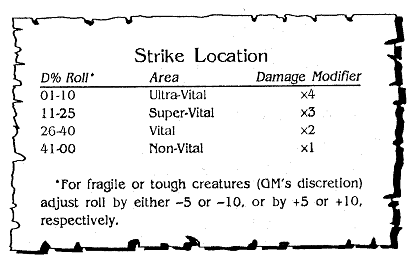
Strike Location


If a hit gets through without being parried (or if the players just decide to take the damage instead of broaching that particular barrel of nightsoil), then roll d% on the Strike Location Table to determine where your mighty swing hits.


No, that is not a bad joke on my part. That is the unified Advanced Mythus hit location table for any and all creatures in the game world in its entirely. Roll d%, get a damage modifier of x1-4. That's it.

Honestly, this is all a little disappointing. Given what we've already seen of this game I sure that you were expecting a hit loc' table of positively Dwarf Fortress detail and specificity: hit locations down to the metatarsal and specific internal organ. Instead we get pure functionalism: four Vulnerability Categories (*gluk*) reminiscent of the "This is where you hit him to kill quickly, or slowly, or to cripple" speech from Spartacus (the movie, not the even more homoerotic tv show). 

To add insult to injury the hit locations aren't even defined in a non-abstract way, they're nothing but damage multipliers. Would a mere dozen words expended on "Ultra-Vital = face or groin, Super-Vital = neck or guts, Vital = torso, Non-Vital = limbs" have broken the word limit, or somehow imposed crippling constraints upon EGG's creative vision? Obviously so.

And the waffley footnote that "fragile or tough creatures adjust roll by +/-5-10" is neither nowt nor sommat: a mere house rule. If WFRP 1E can expend a few lines explaining how the sole hit location table can be modified to take into account the wild variety of non-human physiologies in a fantasy world, then a game with seven types of standard physical damage which spends more than two pages on its Buffoonery skill has no excuse.

One other point to note: looking at the above table suddenly Special Hits don't seem so special any more. That rare '1/10th of skill, maximum damage' hit will be overshadowed by doing average damage but hitting in Vital or better area 40% of the time.

More than half of the Strike Location section of the Physical Combat rules is taken up by something semi-related: the mechanics for using a specific sub-area of a Weapon K/S area:

The opportunity to select one's damage multiplier? Yes, I am interested. Please go on.

Roll to hit as normal, then roll Weapons, Special Skill (Specific Target).

Success = choose your damage multiplier. ("Hurr durr. I choose x1.")
Failure = roll on the Strike Location table w. a +20 modifier. >100 = miss.

And that last disappointment disposes of Step One of the combat summary: hitting. We now move onto Step Two: hurtin'.

Applying Physical Damage


If damage isn't parried, and the person using these rules hasn't lost the will it live by now, damage is done. Armour will (probably) soak some of the pain, and the remainder hurts your HP or monster Monstrous Persona. So, that's a classic soak mechanic which is an RPG Orthodoxy at least as old as Runequest, and probably has even hoarier antecedents in wargaming.

Of course, this being Mythus it doesn't remain a simple deduction operation. There are tables to be cross-referenced of course! Each of your four Vulnerability Categories has separate armour scores for each type of physical damage. The worked example of some dude in maille and shield takes up the better part of a column.


Say it with me now:"AC5".

Yes, the negative numbers are intentional. As regular readers may recall, lightning damage is to armoured warriors in Advanced Mythus approximately what King Herod was to infant schools. So inventing some form of primitive lightning rod will probably be a priority for any tinboys who manage to drag themselves through character generation ~and~ armour calculation with an ounce of their sanity intact.

To add final insult to injury we're informed that magic armour doesn't have any of this number crunching to deal with. Magic armour - being magickqkc and thus inherently better than dirty mugglemetal - has one armour value per Vulnerability Category against all types of damage.

FFFFFFFUUUUUUUUUUU-!!!


It's at about this point a sane person would be thinking: "Hmmm, is my game perhaps too fiddly?"

Wound Level, Critical Level and TRAIT damage thresholds get name checked and defined again, along with a page reference to full rules (on p256) for the Shocked, Dazed and Permanent Damage conditions.

Shocked, dazed and permanent damage about sums up my experience of the Physical Combat, Lethal rules so far. The whole thing is just a morass of simultaneously abstract and over-complex dissociated mechanics [link] with little meaningful relation to one another.

Particular niggles:
  • You can hit the dude, and that's it.
  • FAC Modifiers could do with being simplified and rationalised.
  • Dodge bonuses are so insignificant as to be all but meaningless.
  • Rules for Crits/Fumbles during the deadly, high-stakes dance of blades are both abstract and dull.
  • There is no relationship between accuracy of hit and actual damage done. Acceptable in a game as abstract as OD&D, just insulting in a game as complex and fixated on 'realism' as Advanced Mythus.
  • There is only a single (very specialist) option for modifying hit location. An option of which effective utilisation will require more system mastery than most players will care to invest.
  • Seriously, you call that a hit location table?!
  • The parry rules are a clunky, half-done job and fill me with displeasure on many, many levels.
  • There is no option whatsoever for using Heka in Physical Combat. No one-off accuracy increase, no way to enhance dodge or parry bonus, or no damage boost: nothing.

The bulk of pages 230-231 are taken up by additional rules and notes of special cases which may apply to Physical Combat, Lethal in certain circumstances. These are: Susceptibilities, Invulnerabilities, and Exceptional Attacks.

Susceptibilities


Some creatures suffer additional Physical damage from certain substances. This is Wounding type damage, which is a new one on me. The list of magic allergens should be eminently familiar to any role-player or reader of horror fiction:
Silver, Crystal, Iron, Fire, Irridium(?!), Salt, Wood, Blessed Water

Contact: merely touching the inimical item will cause 1d3 damage (or minimum weapon damage) to the susceptible. Salt and Blessed Water cause 1d3 damage per oz, with 30-80% of possible damage being done by bulk applications.
Insinuation: stabbification causes the susceptible x2-10 normal damage after all other modifiers (Armour, Hit Location, etc.).

There are also rules for non-weapon Susceptibilities (garlic allergy?) later in the rulebook.

Invulnerabilities


These are classic D&D-style immunities to [named thing], usually balanced by a corresponding Susceptibility to [other thing]. Usually all-or-nothing, and players will usually have to puzzle out the Achilles' Heel of whatever creature they're facing.

Exceptional Attacks


These are basically rules for screwing characters over with attacks which don't do much direct damage, but still have a catastrophic effect if they take hold. Snakes and swarms of insects are the cited examples, but we're informed many other types of (undefined) attack also fall into this category.
  • Unarmoured individuals are allowed to parry such attacks and/or attempt Avoidance [link].
  • Armoured individuals either suffer automatic attacks per round (by swarms of killer bees), or have to suffer a Super- or Ultra-Vital Hit to be affected by scorpion stings, snake bites or poison blow darts.

Would I use these rules? Nah, Classic D&D does all this with exception-based rules found in the monster descriptions or with Saving Throws.

Tying It All Together


An extended worked example is spread over three pages (pp232-234). The only way it differs from any other worked example you have ever read is that the example GM is a fan of seemingly arbitrary dick moves that screw the players.

-----

In Conclusion: the Physical Combat, Lethal rules of Advanced Mythus are loosely jointed, dissociated, and all kinds of scrappy. There's very little coherence of elements into a symbiotic whole, nor is there much sense that these rules are part of the same system as the rules for Mental, Spirit, or Non-Lethal Physical Combat.

In a section which almost requires a clear, orderly progression of useful information, the characteristic Mythus sins of dense formatting and verbiage are *still* in full effect. As is often the case, a good hard proofreading and procedural precis/ing wouldn't have gone amiss.

In its entirety the Physical Combat, Lethal section reads like nothing so much as a heartbreaker version of AD&D combat written by a guy who liked Runequest but couldn't be bothered to deliver the full RoleMaster level of complexity he originally envisioned.

I cannot, in good conscience, recommend these rules to others. They are beta release quality in a world where superior finished articles already exist.

Next time: Weapons and Armour, 20 pages thereon. And, yes, there will be pole-arms.

Pic Sources: Dangerous Journeys: Mythus rulebook, the intawubl

Monday, 4 June 2012

Lets Read Mythus pt16

[note: His Nibs is away. This posted through the dubious magic of Blogger's scheduled post facility.]

K/S Usage for Economic Gain
This terminal section of the Core Game Systems chapter was co-written by EGG and his son Ernest, and is probably the only example of father/son tag-team game writing I’ve ever seen. It comprises seven pages on accumulating filthy lucre by standard boring capitalist methods (i.e. not glorious merry theft or looting). The rules presented are rather abstract, involving lots of basic sums and die rolling and not much actual adventure.

There are three methods of multiplying money by money in Advanced Mythus:
  1. Ownership of Real Property
  2. Consultation Services
  3. Professional Investment
Three big-ass tables showing which skills governed by which TRAITS are good for which kind of moneymaking. AFAICT without checking thoroughly every skill in the game is mentioned in one or other of the three. Say what you like about Gygax pere et fils, them boys are Swiss in their thoroughness. Thus:


Completist, prescriptive, dubious utility: must be Mythus.

WAKE UP! If I have to be awake while I flense some sense out of this, so do you.At least we have sweet, sweet booze to help us.

Ownership of Real Property
Making money from owning physical stuff and exploiting its use value.

1. Invest up to 5,000BUCs x STEEP in something related to a chosen skill (farmland and tools for Agriculture; a forge and tools for Smithing/Welding; presses, ink and paper for Printing, etc.). This investment is tied up for a minimum period of one game year.
2. Determine start-up period: 4d3 months -1 month per 10 STEEP
3. DM determines Difficulty Class and modifiers to base chance of success. No help here, not even a page reference. I quote: "This is left strictly to the GM."
4. Add 10% of any other relevant skill to base skill, then divide by DR.
5. At the end of the game year, roll d% to determine profit/loss.
  • Pass/Fail = Each percentage point under/over the target number = 1% profit/loss.
  • Crit = As Pass, plus you get an additional d% profit and 1-3 points added to the skill used to make the roll. In future you can squander invest 2d3x5,000BUCs per skill point in this field.
  • Auto-Fail = Break even, but investment money is tied up unproductively for an entire game year. ("Eh?")
  • Fumble = As Fail, plus an additional d% roll loss. Yes, you can end up losing more than you originally invested.

5. Adjust value of investment:
  • Crit = +20% of initial investment
  • Pass = +10%
  • Fail = -10%
  • Auto-Fail = -20%
  • Fumble = you've probably already lost your shirt...

At the end of the year you can either maintain the investment, rolling again for income year after year, or just sell it off. There are no rules for market variations or anything like that: you get back what's left. 

The worked example is a half-a-page or so about farming.

*Phew* Who knew that attempting to own stuff could be such a hassle.

Consultation Services
Making money through the pretence you are a reliable and trustworthy authority on something.

1. Spot/create need for your skilled services in Law, Linguistics, Seamanship, Occultism, etc.
2. Contact potential clients
3. Pitch potential clients
4. Set price and negotiate payment
5. DO STUFF (I think this is where the skill roll happens)
6. Collect payment, or at least try to.
7. Determine reactions of customers and others affected by your interventions. A big deal is made of the complications of trying to get money out of people who owe it to you. It all gets a little Hackmasterish in the sheer level of adversarial GM-ery:


Screw them over. Gotcha.

8. Determine effect on SEC, income, net worth, etc.
9. Determine effect on future uses of that skill.

The worked example has almost nothing to do with the rules presented above, instead being the story of an apprentice wizard consulting a scholar about translating an obscure text. They end up eaten by a demon. And the reader ends up none the wiser.

Do I liketh this?

No, I liketh it not. Not at all. That page could have been used for something! (*gluk gluk*)

Professional Investment
Judging from the list of skills that can exploit this option (Buffoonery, Thespianism, Influence, etc), this would appear to be something of a ‘impresario’ mechanic. Printing and Chemistry are also mentioned as possibilities. I’m not entirely sure why: are roving bands of chemists-for-hire a thing in Mythus-world?

1. Study the market for one week, uninterrupted.
2. Gather resources. Spend up to 2,000 BUCs per STEEP in selected skill.
3. Have an action plan. One which takes into account such things as:


Look! Indenting! Actual, real honest-to-goodness indenting.

4. Have a clear idea of the goal.
5. Invest time: 4d6 - 1/10 STEEP in weeks.
6. Roll skill check, add 10% of any other relevant skills involved the multiply by DR (usually "Hard"). The worked example specifies that you can bring in outside help for either a set fee or percentage of the gross.
  • Pass/Fail = Each percentage point under/over the target number = 1% profit/loss
  • Crit = As Pass, plus you get an additional d% profit and 1-3 points added to the skill used to make the roll. In future you can invest 2d10 x 2,000BUCs per skill point in this field.
  • Auto-Fail = Break even. (Once again. "Eh?")
  • Fumble = As Fail, plus additional 2d% loss.
On a Fail or Auto-Fail you’re out 10-30% of investment on top of your other losses, but you have the option to plough in more money to re-work the plan (and gain a re-roll to the skill check). The cost of this re-working is to top up the lost 10-30% of the initial investment, then spend +50% more money and time.

The worked example for Professional investment (Rodney the Reformed Thief attempts to set up a troupe of acrobats and jugglers) takes up a larger word count than the rules.

Worked Examples
The section ends with one last page of examples showing how you can use three sample skills - Agriculture, Apotropaism, Architecture (Really? The first three on the list. You were really reaching there, weren't you lads...) - to make money.

I'm not keen on this particular part of the Advanced Mythus system. Seven pages of dense text and poorly formatted rules in investments, and the outcome is decidedly sub-optimal IMO.

Section #1 (Real Property) is basically a skill roll, and #3 (Professional Investment) is #1 tinkered with to explicitly include the existing Combined Effort rules (see p124). I'm not sure the two actually differ enough to justify entirely separate rules; a couple of notes to one block of rules would do the trick. #2 (Consultation Services), well, that’s so vague as to be a waste of paper. You might as well just refer to the Core Mechanics section.

It’s a shame really. The whole K/S Usage for Economic Gain mess could have been rejigged into something short-and-sweet - and a sight more flavourful - with a bit of effort. One investment mechanic, one 'hire yourself out for pay' mechanic, plus a big old random table or two of complications to your clever moneymaking scheme (e.g. 75: Your investment is infested with Gnomes, deal with it or lose d% of value). And change the title to something catchier, like "Getting Rich Without Having to Die Trying" or "What Are We To Do With All This Lovely Money?".

In conclusion: skip this bit. Traveller and WFRP (or, more recently, ACKS) did trading/earning a living better. Heck, K.A.Pendragon does return on annual investments with more character in an appendix, and that's a game where money can be handwaved entirely.

Just goes to show: if your problem is runaway Gygaxian acturialisms, the solution probably isn’t to add more Gygaxes (Gygaxii?).

Art of the Section
The best thing in this entire section is this pic of Sir Beardknight de Beard and a dragon having a shouting match about something.


Now where have I seen that before?

Oh yeah:


-----

And that is the end of Dangerous Journeys: Mythus Chapter 11. Let joy be unconfined and frolicking in the park be the order of the day, at least until next we board the Mythus party bus (NSFW).

Next Time: Our first toe-tip into the piranha-infested river of wordswordswords that is the Combat chapter. Early highlights include: the dark arts of surprise and avoidance; enough information on Speed Classes to make the cold black heart of your average AD&D player flicker into life again; and giving those you disapprove of the explodo in the head and soul.

Pic Source: Dangerous Journeys: Mythus rulebook, the intarwubz

Monday, 28 May 2012

Lets Read Mythus pt15

Dangerous Journeys: Mythus + opinionated gabshite + alkyhol: mix and stand well back.
You know the drill by now.

A note to the confused: You will see references thought-out this stream-of-consciousness jabbering spree to something called That Damn Table. I include it here again for reference purposes:

To know it is to loathe its ubiquity.

Today we’re going to cover the last batch of Advanced Mythus K/S Areas, then have a brief rant on how I’d have done things differently (and arguably better), before finally talking about the incidental art of this section of the book. It’s gonna be a long one, so charge your glasses.

And we start this week’s final thicket-thrash with:

Mediumship
Described as the reverse of Exorcism, this is the art of inviting spirits to appear for the purpose of wasting everyone's time with table-rapping "Your grandfather sends platitudes but no useful directions to where he buried the gold/hid the title deeds" antics. No compelling of spirits is allowed, and failure/fumble "...could bring a hostile or malicious entity..."

Bored now.

We're offered two paragraphs of rules for séances. Said exercises allow the Partial or Full Physical Manifestation (given their own TLAs as P-/FPM *gluk*) of spirits through ectoplasm (or, as the Victorians knew it, oiled muslin) leeched from the Physique TRAITS of séances participants. The benefits of having a spirit Physically Manifest escape me. I've checked the index, and that either sends you into a "refer to" loop, or to an entirely unrelated appendix. F--ing amateurish. Rules for resisting potential unwelcome ectomonglers? Left in the lap of the GM, presumably as extra credit homework.

Bored and irritated by half-assery now.

Characters with the Mediumship K/S Area also gain access to Medium Castings in accordance with the inevitable reprinting of That Table. According to all the tables relevant to this section Mediumship does generate Heka, but there's no mention of this in the text.

Bored, irritated and wishing this skill description would die in a fire now.

Would I touch Mediumship for an Classic RPG? As written, no. In fact: Hell no! Advanced Mythus Mediumship reads like it belongs in an Arcana Victoriana game like Forgotten Futures 4 and 8 or For Faerie, Queen and Country: it’s gutless, deracinated spirit magic for the bored middle classes in a pre-TV age. I get that it’s also supposed to represent the character invoking ancestor spirits, genius loci, ideolectic gestalts, etc. but the flavour text and rules on offer are far too Derek Acora [no link, the man is vermin] for my tastes.

Metaphysics
We’re given the better part of a paragraph of definition of metaphysics before EGG cuts to the chase and explains it in game terms. It turns out that under all the philosophy syllabus waffle this is a non-evil equivalent of Demonology with the option to make "roll to detect celestial influences" checks. So, angelology for a world with stabbable spiritual entities. ("Jeez EGG, that’s all you had to say.")

As well as generating Heka, which is pretty standard issue for an Advanced Mythus Spirit skill, Metaphysics also has a half-baked ‘gain Spiritual strength’ rule. At 41 skill, and at every 10 points gained thereafter, a person may make a "Hard" (x1) difficulty Metaphysics roll to gain a point of SMCap. After gaining two points thus the difficulty of future rolls increases to "Difficult" (0.5). Hey, free stat points. Shame that none of the Physical or Mental skills enjoyed such an advantage.

Metaphysics skill as written is all over the place. It’s academic metaphysics, and stat-enhancing meditation/spiritual exercises, and an detect angelic meddling skill, AND a spotter’s guide to celestial beings too. I’d probably break this into a couple of skills if I were going to make use of it at all.

Multiversal Spheres & Planes
Knowledge of the position and makeup of the multiverse, divided up by plane.

Eleven sub-areas:
  1. Alternate Material Planes
  2. Elemental Planes
  3. Shadow Plane
  4. Negative and Positive Planes
  5. Aethereal Plane
  6. Nether and Pandemonic Planes
  7. Empyrean and Concordelysian Planes
  8. Entropic and Celestial Planes
  9. Temporal and Panprobable Planes
  10. Abyssal Plane
  11. Astral Plane
All that lot fits together in a manner which may look more than slightly familiar to AD&D veterans.

Yes, because the problem with AD&D’s Great Wheel cosmology was that it wasn’t complicated and prescriptive enough.

No useful information or stealable moving parts in this skill description. It just sits there without even a helpful reference to the Mythus Magick book where the cosmography of Advanced Mythus is actually explained. More and more I begin to fear that this game isn’t actually comprehensible without the Mythus Magick book in close attendance: not quite 400 pages of crippleware, but dangerously close.

Musical Composition
You can make up instrumental music, but not write lyrics (because that’s an entirely different discipline, roight?). The Musical Composition skill generates Heka if you have all three of Spellsongs, Music and Poetry/Lyrics. A character with this skill can also read music with a DR of "Easy". Even someone afflicted by the bane of music dyslexskia (like Skwizgaar Skwigelf "I do nots wish to talks about it") finds this last a bit eyebrowish. Is sight-reading so risibly easy?

Musical Composition has no skill cross-feeds (no, not even to the obvious ones) and no sub-areas. I find that last a bit peculiar, as what constitutes ‘good’ composition in, for example, the classical Chinese musical tradition != ‘good’ in the traditional West Asian or European modes.

Mysticism

Ooh, this sounds like it might be cool. So what kind of mysticism does Advanced Mythus deem worthy of coverage as an entire skill in its own right? Sufi? Buddhist? Taoist? Qabbalist esoterica? Blakean whackdoodlery? Nope, this is 70s Californian mysticism, so we get two pages of rules about crystals and crystal-derived woo-powers.

Ah yes. Those powers. A mystic knows eleven of them, listed A-K:

A. Self-Improvement: meditate 1 hour/day and make an Easy skill check to gain +1 per 4 bonus to AP/General awarded. That means "25% bonus to XP" in standard gamer.
B. Self-Healing, Heart & Mind: meditate 2 hour/day and make Hard skill check to heal 2d6 damage to both Mental and Spirit TRAITS. 1/day.
C. Mental/Spiritual Defence: presenting your crystal as a shield awards Armour vs. magic effects that harm mind or spirit according to the table below:


D. Mental/Spirit Offence: allows the crystal-waver to attack manifested spirits using 50% of their Mysticism or Dweomercraeft skill.
E. Mental Heka Force Amplification: meditate 1 hour + Hard skill check to boost one Heka-using skill by 50% for 5 minutes. 1/week only.
F. Heka Concentration: meditate for up to 2 hours + make Hard skill check to dump 1 Heka/minute in crystal.
G. Visions: using Mysticism to "clue me" is one DR easier than normal when using a crystal as a focus.
H. Self-Healing, Body: as power B, but a Difficult skill check. 1/day.
I. Heal Others, Mind & Heart: as power B, but base difficulty of Hard, +1 DR per additional person healed. 1/day.
J. Heal Others, Body: as power I, but for others. 1/day.
K. Scrying: "Easy" skill check to see invisible presences. Rules on types of crystals required to scry other planes.

Access to the above powers are governed both by state of mind and by the purity of the crystal the mystic has attuned (navel gaze for 7 hours, Easy skill check). The requirement that mystics "...must be sane, sober and not Dazed to use a crystal with any degree of success" which just goes right against the grain of verisimilitude for what we actually know about Californian mysticism.

As well as dictating your ability to use your skill crystal quality also gives modifiers to base DRs ~and~ determines the Heka storage potential of your pet rock. All these factors are determined by crystal price, which makes hearty mock of the outmoded concept of mystics as people who abjure earthly wealth.


A textual note says that high quality rocks can be X2-3 the listed price. I wouldn't have objected to this information as a second footnote to the table.

In addition to the powers above the Mystic gains Mystic Castings according to That Table, generates Heka, and has access to two additional perks:

Dreams & Visions: another "obtain clue" skill, with DR determined by how often in the past month the mystic has bothered the sublime crystalline entities (or whatever) that his little tchotchke(sp?) resonates with. The reading referee is cautioned in special invisible to players italicised text not to dish out too many clues in response to "clue me" skills. EGG sagely reminds us to "...always make the HPs work for most of their information. [...] Thinking is worth a score of successful die rolls."

Detect Spirits and/or Magick: a Mystic, or maybe his crystal, will *ping* in the presence of spirits (detection DR is dependent on magnitude of manifestation) or magic (Base DR "Extreme", one DR easier per 100 Heka expended), or if the Mystic or his friends become the subject of a magical Link. No idea about what this last entails, but I console myself with a delicious soothing beverage. (*gluk*)

The downside to using a pretty stone as a lever to move the world? Anyone else touching your crystal scrambles the attunement (hippies don’t share well); your crystal crumbles to dust if you ever fumble a Mysticism roll; and lastly, you are a pretentious crystal-gazing woo-monger.

As you may have surmised by now this skill contains the makings of a pretty comprehensive patchouli-scented Hippy Crystal Chick class, if that’s something that floats your boat.

Nature Attunement
This is Druidism as skill. Unfortunately it’s not the cool ‘20 years of training, then you get buried alive in a flooded coffin to compose your dissertation in verse’ druidism the Romans wiped out, but instead tediously worthy ‘listen to the land’ crying Indian/GROLIES one. I’m really not kidding:


purity, sense, feel: nice of Gary to highlight the hippy detection keywords for us

Doing any of the things listed above is DR "Hard". Users of this skill can also blend into natural surrounding at a base DR of Easy, modified by terrain and vegetation.

Finally Nature Attunement has five non-standard sub-areas:
  1. Growing Things
  2. Natural Cycles
  3. Personal Relationship
  4. Animal Husbandry
  5. Exotic Places
Instead of actually doing anything useful in their own right all these sub-areas do is provide cross-feed to other skills:

Growing Things gives 10% cross-feed to Agriculture and Herbalism,
Natural Cycles cross-feeds to Ecology and Geology.
Personal Relationship (grossly mis-named) actually benefits your Hunting/Tracking and Survival skills. Go figure.
Animal Relationship cross-feeds to Animal Husbandry, but not at all to Riding or Animal Handling.
Exotic Places cross-feeds to Phaeree Flora and Fauna and Subterranean Aerth knowledge.

The highly developed spiritual and metaphysical connection to the living world granted by Nature Attunement does not generate Heka in any way shape or form.

Necromancy
One of the bad-boy rock star magic skills. I’m sure you don’t even need this defined for you, right? Ha! This is Advanced Mythus, of course it gets defined! Cue one very skippable paragraph of thesaurus abuse (*gluk gluk*) telling you what necromancy is. Of course it generates Heka, and of course you gain access to Necromancer Castings according to That Table.

Most of the word count in this skill description is expended on 3 rather unimpressive abilities you gain by virtue of sending off for your mail order skull ring. I’m almost embarrassed to expose EGG’s nomenclatural shame here, but:
  1. Coldbody - lower body temperature by 1° F per skill point for up to 1 AT (5 minutes) per STEEP. One/day AFAICT.
  2. Darksee - infra- and ultravision by other names. You see in the dark as if it was twilight. Always on.
  3. Shadowskulk - hide in shadows. DR Easy (total darkness) or harder. Lasts 1 BT (30 seconds) per STEEP. One/day.
So sad. You’d expect a fan of Vance, KAS, et al to be better at evoking the terror and majesty of Death Magic (yes, it rates the caps) in his ability names, wouldn’tcha? I mean, I can throw "Chill of the Grave", "See in Darkness" and "Enrobed in Night" down as substitute names with precisely zero thought on the matter.

Anything worth stealing here? Naaaah. Advanced Mythus necromancers can’t even animate zombies from the look of it. You’ve probably written a better necromancer class yourself, or know a guy who has.


Occultism
Knowledge of the names and hierarchies of ghosts, elementals and similar entities: a handy skill for mediums, conjurers or anyone else determined to get bossy with those bodiless folk in the spirit world. By contrast with the needless wordiness of many Advanced Mythus skill descriptions this one actually feels rather like a précis of a (missing) longer section on spirit magic and Truenames.

Learning about spirits is easy; a simple d% roll determines whether or not you learn the name of a useful entity. On a success skill check the character learns a spirit’s name and then rolls two more d% to determine whether they know it’s supernatural rank and/or leverage-enabling Truename (see table below).


Spirit entities have a crazy number of names, anything from three for the lowliest up to eighteen names for the most powerful. I’ve no idea what use this information actually is; it’s just thrown out there with us left to infer it by reference to other Spirit skill descriptions (Conjuration, Sorcery, etc). Creatures of Major status or above have multi-part Truenames that can’t be wholly learned through Occultism. Don’t ask how you can learn their full Truename though; the text is stonily silent on the matter.

Occultism has no sub-areas or cross-feed to any other skills: an all-or-nowt skill. It does grant Heka = STEEP, but there appear to be no Occultism castings, so for once there’s no Special Guest Appearance from That Table.

Whether you’d ever make use of this skill in your non-Mythus game depends on whether you care for Truenames, or for creatures having a dozen or more situational epithets. Personally I’ve always found that "I am known by many names" mythology shtick a bit pretentious and vaguely absurd. Too many aliases = cheap and shifty in my book.

Painting (Artistic)
Distinct from Painting (House), which seems to be missing (*tsk*). Characters with this skill can make pretty pictures [link], assess the value of artwork (toe-trampling makes Appraisal skill saaaad), and also know art history. Painting as a Spirit skill though: is that right? Let’s just take the snide historian gibe about art history not being a proper intellectual discipline as read and move on, shall we?

Pantheology
Mythology knowledge. In a world with manifest divinities this is probably something more than just a gateway field of study for geeks; knowing which god to make propitiatory obeisance to may actually be useful. The skill grants broad general knowledge about all pantheons in the game world, but the further away a pantheon is from your home culture area, the harder are skill checks required to remember salient information. Proximate pantheons are "Hard", those more distant "Difficult" or "Very Difficult".

Sub-areas can be taken (to no apparent benefit), and there are nineteen of these listed, from Atlantean to Voudoun.

This skill is simultaneously vague and game world specific; a lot of work for the player and GM. Pass.

Phaeree Folk & Culture
Distinct from the Phaeree Flora and Fauna skill this is "...the study of the many intelligent races inhabiting the Aerth’s counter-world": poxy pixie politics.

There are six sub-areas to this skill: three Races of [faction] Nature and three Culture of [faction] Nature sub-areas. You can pick the Seelie, Borderer or Unseelie factions as fields of, for want of a better word, interest. No cross-feeds to other skills, and you’re limited to a ceiling of 35 in your skill until you spend time in fairyland.

This is a boring, unevocative take on faerie lore. All the legwork is left for the GM, or to a later (never published) Mythus Phaeree sourcebook.

(Oh, and that misspelling, like Magick and -craeft, just gets more annoying with time.)


Philosophy
Front and centre: "...philosophy adds 10% of its STEEP to the Influence K/S Area" (you remember that particular mess, right?), which is yoking the ‘philosophy and rhetoric = trufriends4eva’ connection a little too tightly for my tastes. What’s the skill good for in itself? Well, aside from being another "clue me" skill philosophy also makes you "...a sophisticated kind of person...", and one "...not easily misled by sophistries and falsely persuasive arguments."

Pwahahaha!!! Oh my sides! I can only wonder how many philosophers EGG ever met.


Poetry/Lyrics
Good for writing odes, sonnets, ballads, librettos which don’t grate on the ear (DR "Easy" or harder). The skill also covers critical analysis and history of poetry and music.

Poetry/Lyrics has no sub-areas, but does cross-feeds 10% to Etiquette/Social Graces, which bonus "...applies across all cultures and societies", as we are informed in italics most grave. Poetry/Lyrics also grants Heka to a character provided they have some ability in all three of the Spellsongs, Music and Musical Composition K/S Areas.


Priestcraeft (sic)
This chunky page-long description open with two paragraphs on determining Full or Partial Heka Ability, which is practically a reprint of the similar section in the Dweomercraeft skill description. I’ve said it before, and I’ll say it again: not the right place for this rule.

After this we’re introduced to the requirements to become a full-fledged priest. These are:
  • Full Heka Ability
  • STEEP of 31+ in Religion K/S Area (q.v.)
  • Exclusive devotion to one god of one pantheon
  • Vow of Faith/Pact with Evil (depending on whether your god is white or black hat) to chosen god

In return for all the above you gain both crazy Heka and access to a bunch of special Tutelary Castings specific to your ethos. In return you are at the beck and call of an inscrutable, omnipotent egomaniac (already a familiar experience to many players). Non-priests with the Priestcraeft skill gain somewhat less Heka and have access to non-Priest Castings in accordance with That Table.

We’re informed that, unlike many skills, Priestcraeft has ‘insular’ sub-area. Once the pomposity has been hacked away (I kid you not, the word ‘Ethoi’ is used no less than three times in one paragraph!) it turns out this means: "pick the sub-area of Priestcraeft that matches your god, abjure all others; that’s you now."

The five Ethoi of Priestcraeft are:

Balance - disinterested neutralism. Taoists, nature worshippers, etc. Has some overlap with the Elemental School of Magic. Basically this guy:


Gloomy Darkness - black hat maltheism. Combines chaos with tyranny for delicious full-fat double evilburgerness. Has so much in common with the Black School of magic it ain’t even funny.
Moonlight - ‘little from column A, little from column B’ omnivorous ethos. Moon and sea gods.
Shadowy Darkness - grey hat darker-and-edgier antihero ethos. Non-evil gods of death (Osiris, Hades, etc.) hang out here. Has a lot on common with the Grey School of Dweomercraeft.
Sunlight - white hat light and order. Sun gods, lawgivers, etc. Corresponds to White School of Dweomercraeft.

Not much of use here for Classic RPG gamers. Classics players generally already have god-bothering rules to their satisfaction.

Religion
Knowledge of the rites and rotes of any one religion and pantheon, which must be chosen when the skill is taken. A STEEP of 31+ in this skill is required to be an ordained Priest of a temple. The skill generates Heka, but appears to have few if any in-game uses.

Sculpture
The art of making sharp, vivid, three dimensional images from physical stuff. A necessary skill for anyone with a yen to shape golems. Sculpture offers no sub-areas, because the skills involved in casting bronze, carving stone or wood, shaping clay, or shaping jade are all same-same. The skill offers no skill cross-feeds, mainly because as written it's just too broad and vague to meaningfully apply to Masonry, Forging/Welding, Carpentry (another mentioned-but-MIA skill), Jewellery, etc. But hey, those are just lowly Physical skills; it’s not like they do actually matter in Mythus-world.

Sorcery
The other bad boy rock star magic skill. This is the one that lets you grow a goatee, dress in full Halfordian mode and generally act like the villain in the film adaptation of a Dennis Wheatley book. Provided you have even a smattering of skill in the Demonology K/S Area, and are prepared to make a Pact with Evil (Vow of Faith by another name) forfeiting your soul, this is the full-on demon magic.

Yeah, almost exactly like that, wicker man and all.

What do you get in return for selling 21 grams of spiritual self?
  • a non-trivial multiplier to the Heka generated by this skill. The text says anything from double to ten-times normal, but I think we all agree that x6.66 is the most thematically appropriate.
  • access to Sorcerer Castings per That Table.
  • the ability to call up infernal entities to do your bidding, Faust-style
Which segues us nicely into the half-page of demon invoking rules. These are largely a copypasta of the Conjuration rules with specific reference to evil-themed paraphernalia. The Heka cost and difficulty of upsetting the MADD element is given in a table coyly named "Called Beings":


But wait! There’s more. A sorcerer also gains five innate ‘in the inverted pentagram club’ minor powers. The names of these last aren’t as groan-inducingly bad as those listed under Necromancy, but they’re still not much to write home about.
  • Delusions - win a contested K/S roll to mentally troll ("Look again. You’re eating maggots.") a person within one chain (66ft), up to 3/day.
  • Flamesdance - control flames. Flames can be made to flicker, dim or expand in size by up to x6(.66) for damage + chance of setting things afire. Usable 1/day.
  • Impsummon - you get a squeaky little infernal minion to order/kick about. Usable 1/week.
  • Kiteseyes - you can see through the eyes of any carrion bird out to a maximum range of 6 leagues. 1/day.
  • Ratseyes - you can see through the eyes of rats. Mean-spirited mice and black squirrels are also "...good candidates for being pawns of this power!" 1/day.

There is a Carcosa-style suggestion that you can exploit the knowledge provided by this skill to fight evil, so long as you don’t summon demons, make pacts, or cast the naughty Sorcery spells. ("Goat Boy finds that disgusting. Where is the fun in that?")

Is there anything here usable for a Classic D&D game? Not really. AD&D already has a string of mid-to-high-level summoning and binding spells that form a perfectly adequate demon-bullying mini-game in their own right. It is refreshing to see EGG just plain not giving a phuq about possible ‘RPGs are satanic’ clucking though. The sorcery skill has a definite air of "This is the subject matter under discussion and honi soit qui mal y pense".

Streetwise
The ability to fit in and not embarrass yourself among sub-cultural groups within your own culture. Examples sub-cultures listed include urban proletariat, rural peasants, mercenaries, beggars, etc. You know one sub-area of non-standard etiquette per 10 skill points. The skill is also good for identifying those groups traditionally shy of local law enforcement.

Thespianism
"All that fuss. Why not just try acting dear boy?" - Laurence Olivier to Marlon Brando
Includes both ability to act and knowledge of stagecraft. No cross-feed to Disguise, Persuasion or to anything else you might think related. I’m still not sure if this skill doesn’t render the Impersonation superfluous.

Witchcraeft
Dunno why this is distinct from Sorcery, other than Gary had a Witch class bug up his butt right from the early days of D&D. IIRC it was an example class as far back as OD&D. Whatever the reason we are informed that "...any individual practising Witchcraeft is of vilest malevolence and dedicated to Evil."


Sooooo Evil! Burn immediately.

After a couple of paragraphs of introductory matter which might as well have just read "refer to Sorcery" (*gluk gluk*) we’re treated to a column or so on the all-important administrative requirements of being a witch. We’re told of the benefits of regular attendance at Sabbats and Esbats (basically bonus Heka: so much for turning up; more for being boss hag; even more "...if especially honoured for evil works." I can’t believe that known punster Gary missed the mentioned in Esbatches gag...), and of the swingeing punishments inflicted on witches who fail to keep their covens up to regulation strength: "If ever a coven should have exactly seven members for even as short a time as seven hours, the remaining members are lost, for their Pacts are foreclosed, and each and every one is doomed!"

In return for their dedication to the infernal bureaucracy witches gain their bonus Heka, access to Witch/Warlock Castings per That Tables, and two witchy-themed minor powers:
  • Eyebite - give someone the Evil Eye. This is basically a pre-incarnation of the SRD’s silent/still spell feats.
  • Beastform - the witch can adopt the form of a totemic carnivore (wolf, bear, or big cat) between midnight and dawn on nights when the moon is either full or dark.
Could you use this as the basis for a Classic RPG witch class? Not really. Half the skill is a recycling of the (already half-recycled) Sorcery skill, and the non-spell abilities of Witchcraeft are pretty duff. There’s nothing here to appeal to anyone who wasn’t aroused by the internal politics of the AD&D Druid class (one boss per area, fight to advance, etc.).

Writing, Creative
You can make stuff up and write it down, or polish non-fiction into an entertaining read. I’m surprised there’s no self-pitying authorial plaint on the difficulty of writing here; maybe EGG got that out of his system back in the Difficulty Ratings section of this chapter. Creative Writing cross-feeds 10% to the Influence K/S Area, which I suppose represents speechwriting and such.

Yoga
Don’t expect a thorough-going examination of the magic(k)al benefits of a 5,000 year old mystic tradition here, Mythus yoga is fakir tricks, pure and simple. The skill description covers the better part of a page, but the core of it is that the skill grants "...resistance to Mental and Spiritual attacks, immunity to normal fires, the ability to heal Mental, Spiritual and Physical wounds, and the ability to slow physical body functions." All these benefits, as well as innate resistance to Insanity-causing effects, are granted per the Yogi Abilities Table (reproduced below):


As well as making you an unkillable pucnic-basket- plundering hobo the Yoga K/S Area also generates Heka, and cross-feeds 10% to Hypnotism, Perception, Acrobatics/Gymnastics, Endurance, Mysticism and Nature Attunement. Yes, all of them.

You’ve seen this skill before in your Classic D&D game. Split the abilities up among a bunch of levels and you’ve pretty much got the Monk (aka Mystic if you speak BECMI). The body control thing? That was right there in OEPT all the way back in 1975.

And, having reached page 200 alive and (relatively) sane, I am glad to report that is the end of the Advanced Mythus K/S Area descriptions section. 64 seemingly endless pages of:

Mythus skills: my face when

Was it worth the swedge? Arguably not: an average of a couple of possibly interesting elements for your game per dozen pages really doesn’t justify the effort expended. I’m just glad I did it so that no one else has to.

How I’d Have Done It Differently

Before we call finis on this gibbering horror for all time I’m just going to indulge myself with a brief retrospective of the Advanced Mythus K/S Areas section, why it sucks, and how it could be made better. Trust me, this is a necessary exorcism for someone who’s just spent six weeks staring into the void.

The number one improvement would come from having a guy like this on the staff:

"Hello. I'm here to edit your text."

Everything else flows from there.

For starters, the universal skill lists on pp100-101 would have been moved to the K/S Area Descriptions section, with *copious* page numbers and textual references in the Vocations section.

Second, each and every skill would have to justify its existence in the book. If you’re going to have a comprehensive skill system, then it has to be comprehensive, not half-done and lopsided.

Duplicate another skill? We have that thanks. Off you trot.
Stupid number of sub-areas? They get purged and/or the skill gets split up into two or more separate skills, which then have to justify their own existences.
Vapid waffle text? Expand skill description to a meaningful degree, or cut: pick one.

Then, and only then, I’d have put the surviving Heka-active skills in a section of their own, maybe called something sensible and obvious like Heka-Active Skills to indicate that they are not quite like their mundane counterparts.

All the skills would be collected into one table with a fat wedge of relevant information all in one place. Thus:

NameTRAITHeka fromCasting Access?Sub-Areas?Other Abilities?
Arglbarglism M Skill+MMFoo Y (Arglbargl) Y (# of) Y/N (see pXXX)
Chodmancy M Skill+PNBar Y (Choddery) N N
Gonkology P Skill only N Y (# of)Y (see pXXX)
Murblnurfism S Skill+Ssblah Y (Murblnurf) N Y (see pXXX)
etc etc etc etc etc etc

There’d be one, and only one, instance of That Damn Table, renamed to something logical like Casting Access for Heka-Active Skills. The newly renamed table would have a header or footnote explaining that all Heka-active skills that gave casting access did so according to this one table; no exceptions.

After that, Heka-active skill descriptions, edited down to the needful information. Got a bunch of setting material and/or worked examples? That’s what the Mythus Magick book is for. The Rulebook is for the rules you need to play the game. The clue is in the name.

There’d also be one clearly marked and logically placed explanation of the process of checking for Full or Partial Heka Ability in characters. This also would be page referenced to within an inch of its life because we have respect for the time, effort and money the reader has expended upon our game.

Bosh! Greater clarity, ease of reference, ~and~ a bunch of pages saved for more actual substantive content. The whole section would actually read like a usable rulebook rather than as a bunch of half-thought-out fob-off skill descriptions interspersed with setting essays, authorial advice, worked examples and over-stuffed uber-skills.

Job done. I am rock!


Art of the Section
Before I finally collapse into a gibbering heap for the rest of the week I’d just like to mention the three b+w pictures which *ahem* grace the Spirit K/S Areas section of the Advanced Mythus rulebook. All three are b+w incidental art, rather than the full page colour spreads we’ve come to know and loathe.
  • p182 - Daniel Gelon pic of a Faerie Prince and his court, complete with robed eminence gris naturally. Odd bits of this picture include the weird black dot doll eyes of the prince and the Bowie homage(?) focus on his groin as the focal point of the entire composition. This piece is WTF Mythus? territory.
  • p195 - Not visibly credited (Mitchell?) pic of an Ogre standing before a Mycenaean-looking tomb. The ogre is characterfully drawn with a slightly pathetic air which gives the impression that beating on this guy would have a slight whiff of 'bullying the local weirdo' about it.
  • p198 - Ellisa Mitchell pic of a generic Conan-style fantasyburg. This architectural style in this picture will be more than slightly reminiscent to anyone who saw the opening reel of the execrable Solomon Kane film.

Next Time: K/S Areas Use for Economic Gain, in which Ernie Gygax and his old man expend seven pages laying down the law on earning your keep in /Advanced Mythus/.

Pic Source: Dangerous Journeys: Mythus rulebook, Mythus Magick, Action Philosophers, the intarwubz
Related Posts Plugin for WordPress, Blogger...