Showing posts with label tables. Show all posts

Monday, 16 April 2012

Lets Read Mythus pt9

Rejoice! Rejoice! For our month-long grind through Advanced Mythus character generation in search of useful stealables is at an end. We have emerged blinking into the light which heralds a bright new dawn, and the vista which spreads before our bedazzled eyes is:

Chapter 10: Core Game Systems
123 pages into the Mythus book, and we finally get to some actual proper "roll to do stuff" game mechanics. Hopefully all those numbers, acronyms and such will begin to make some sort of sense.

The K/S Operational System
Opens with four paragraphs of blah-blah on abilities and skills in RPGS and the fact that there are mechanics to determine success or failure, with a couple of facile examples. Not worth remembering, take a drink and skip it.

Making Rolls Against STEEP
I can write the mechanic in the same number of words it takes EGG to write that section title: "d%, roll under TN". Snark aside, this is four more paragraphs of text that explain the core Advanced Mythus mechanic: your K/S Chance (ah, never miss an opportunity for some new jargon *gluk*) is your STEEP (*gluk*) multiplied by Difficulty Rating (*gluk*) of the endeavour.

Difficulty in Advanced Mythus is a multiplier to your base skill, rather than the linear +/- modifiers you may be more familiar with from certain other percentile-based RPG resolution systems.


Yeah, the baseline difficulty is to double your skill. Assumption of competence is a nice change of pace from the "you suck and fail, then you suck some more, and then you die" ethos of WFRP. However. Is it just me, or will multiplying/dividing skills scores lead to actual skill level actually not mattering all that much in difficult situations?
"This means that your level of expertise becomes less important, the more difficult a task gets, and a poorly trained character will have fairly meager chances of success even at an Easy task. Gygax is evidently of the opinion that you can tell a true master from a bumbling wannabe by how well they perform an idiotically simple task. At higher difficulties, the differences tend to even out..."
-- Marius Bredsdorff, RPG.net review of Mythus
So it's not just me who noticed that. Here's some back-of-a-napkin figuring:

        STEEP     x3    x2*    x1    x0.5    x0.25    x0.1
Low Starting    17    51    34    17    8    4    2
High -"-     33    99    66    33    16    8    3
Masterful     75    225    150    75    37    18    7

Looks like you'll be depending on dumb luck to save your ass in a crisis, coz that hard-earned skill won't.

So far, Chris no like.

Rolling Against HP Statistics

How fiddly do you want your "roll vs. stat" mechanic? You can roll:

vs. TRAIT (3 stat groups) = half it to find base chance
vs. Categories (6 stats) = use as base score
vs. Attributes (18 sub-stats) = multiply by x2-3

I have no idea when a roll against one's Spiritual Psychic Speed might be the correct one ("I can imaginatify quicksier then youz!"), but it’s nice to know it’s an option. Just... not one that I ever see the need to use.

Combined Efforts
Want to try something stoopid hard? Get half-a-dozen skilled friends in to help, and run that Oceans 11 caper as a semi-narrative montage resolved by a single die roll. The more people involved, the less help they are. No formal limit on how many people can be involved in a combined effort action though.


That’s the sort of rule I might actually use, if I was currently playing in a percentile game, or any game that used skill systems.

Combined Efforts of Diverse K/S Areas

Or, ‘pitching in without expert knowledge’. If you only have tangentially relevant skills you can add 10% of that skill to the skill of the person attempting a thing. It's suggested that only 3-6 different skills can be called on for help in this way. It’s suggested that no more than a dozen people can aid on a project in this manner.

Wow, who’da thunk it: Gary had D&D4-style Skill Challenges – situations where everyone pitches in to help – all worked out in 1992. And in less than a page, although you could still easily trim his wording down to a paragraph or two.

Rolling via Guesswork

This is Mythus-ese for 'untrained skill use'; cack-handed attempts to do stuff you saw a dude do once. Once you flay off all the extraneous verbiage, it’s pretty simple and elegant:

Skill you absolutely no have: skill = 01.
Skill you have, but lack the relevant sub-area: +2 DR.

Of course, this being Advanced Mythus, there are additional "elective complexities":

If you have a related skill, or some common knowledge about a thing, you get a skill level up to its corresponding Attribute (GM call). There's a list of 20 or so skills you can do this with, largely commonsense ones (Domestic Arts, Gambling, First Aid, Sports).

Special Successes and Failures

Crit chance is 1/10th your skill: a naked RuneQuest steal.
Auto-fail and Fumble vary by how skilled you are; more skilled characters bungle it less often.
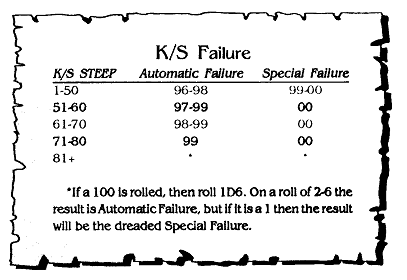

1-in-600 chance of a fumble? Why even roll?

This is a nice change from some mathematically ass-backward (*cough* OWoD) or just plain hateful-to-player-agency (*cough* Fading Suns) systems I’ve seen, but is a little too granular for my tastes.

Determining the Difficulty Rating
A page and change defining the difficulty ratings and offering example tasks.

Oh Gary, you card! You do crack me up sometimes.

We are also offering an expended table of no less than ten degrees of difficulty ("Routine x2.5", "Very Hard 0.75", etc). Great if you want that much granularity, but IMO the extra modifiers in this table should have just been included in the core table as optional rules.

K/S vs. K/S Rolls

Or, as we say in my country (say it with me now): "contested roll". Degree of difference between the two skills involved modifies difficulty in the favour of one contestant and against the other. Both then roll: Special Success beats Success beats Fail beats Fumble. It both degrees of success are the same = tie.


If I read the table (and its page or so of accompanying explanation) correctly having ~20 skill points less than an opponent makes your roll Very Difficult (skill x0.25) and his roll Easy (skill x3). It is obviously REALLY advantageous to have the higher skill in Advanced Mythus.

Frequency of K/S Rolls
Tells you to use your discretion as GM. Subsumed in this non-useful advice are two additional rules which – in a book laid out by the sane - would probably have been entirely separate sections:

Try and Try Again, which defines situations you can and can't attempt a second bite of the cherry. It's column of blah-blah which boils down to

That's ALL you had to say. (*gluk gluk*)

The second needlessly subsumed section, Handling Long Projects, advises breaking large things down into smaller challenges with more rolls (and thus more potential points of failure). *sigh* And for a moment I thought Mythus had left 4E Skill Challenges eating their hearts out in shame. Oh well...

So that's basic core mechanics spread out over six densely packed pages. Although new jargon has been kept within sane levels there are whole chunk of rules would have benefited from an on-the-ball editor with a swift and merciless red pen. It would have been nice to have some better organisation and clearer marking out of what's an essential mechanic vs. what's commentary and advice.

Useful steals? A couple, if you’re a skill-inclined GM. But really, there’s nothing here that shakes the heavens with its innovation or mechanical subtlety.

The Many Uses of Joss
At long last, on page 129, we are given the full speil on Joss. Narrative control points for player use.


Your bucket of Joss points has 9 possible uses:
  1. Modify a DR - can improve your chances, those of an ally, or nobble an enemy by one DR per Joss spent.
  2. Ha ha! I/You hit/missed! - Can cause a single attack by or against you to succeed or fail automagically.
  3. A Mere Flesh wound - Can modify the severity of an inflicted hit; increase to Crit or reduce to normal.
  4. With One Bound... - Escape capture, stranding or imprisonment - 1-5 Joss depending on alertness of guards and degree of isolation.
  5. Clue me - 1-6 Joss depending on magnitude of your "sudden inspiration".
  6. Need a friend? - 1-6 Joss to gain a one-time Special Connection.
  7. Need cash? - 1-5 Joss to simply happen upon no-strings cash = Disposable Monthly Income.
  8. It's Not So Bad - Reduce severity of bad situation: can reduce poison or disease effect; stop your horse from fleeing/being stolen, etc. 1-6 Joss, more "...if it was due to your own carelessness." (A classic little bit of EGG tough love there)
  9. Oh No You Don't! - Negate Joss spent by others on a one-for-one basis.
Pretty standard Fate Point/Grace of God mechanic then. But it is nice to see the limits of what Joss can and can’t do set out so clearly.  Ah, numbered lists and indenting, where have you been all this time?

Movement and Time
Pages 131-132 are rules on movement speed by foot or mount. The hiking/jogging/running rules are pretty unsurprising for anyone who's ever played a classic FRPG, although the inclusion of crawling speed (1/10th normal) and stacking adverse terrain effects are nice. I’d have simplified the latter further and included bloody encumbrance effects, but that’s just silly old me.

The mounted movement rules have much more detail, including mount speed and endurance, and some over-complex rules for riding your horse (donkey, elephant, camel, w/e) to death if that’s what gets you off.

The game time rules are largely a rehash of the nested Action/Battle/Critical Turns introduced in Mythus Prime. Two columns of worked examples and hypothetical situations, but otherwise RPG standard. To my shame I only just noticed the A/B/C notation, which is intuitive, but obviously not /that/ intuitive.

The Game Time vs. Real Time section is nothing that the AD&D DMG didn't do first and with more character (and ex cathedra ALLCAPS). The suggestion that a week of real time between sessions = a month of Mythus game downtime is quite cool. That’s your monthly living costs, training time, recovery time, etc. all covered by one simple rule. Knocks the old '1 adventure per level = lord of all you survey in 10 weeks of game time' thing on the head slightly.

Accomplishment Points
Advanced Mythus has three types of not-at-all experience:
  • General, 
  • Specific K/S STEEP and 
  • Exceptional Performance APs. 
This is obviously both logical and necessary. I mean, how on earth did we manage for 20 years with only one type of XP? As you'll see below, they seem almost like two entirely separate advancement systems kludged together and/or thrown in for the sake of completeness.

General AP
Abbreviated AP/G. Awarded at the end of a scenario, 1-20, with around 10 being the average. Expended in a non-obvious manner to buy new character goodness. There are limits to how much AP you can spend on a skill per time period, but AP/G can be saved and expended weekly during downtime.

  1. Add skill points: costs 1-2 AP = +1% to a skill, up to +5% per adventure. Cost varies depending on what your character’s Prime TRAIT is, which is mildly reminiscent of 3E’s hateful concept of cross-class skills.

    Want a skill not related to your TRAIT? Go suck a fat one.

  2. Specialise in a skill sub-area: This self-gimping costs! 5-10 AP and two weeks of game time training.
  3. Buy new skills: costs 5 AP + 1-2 per 1% of skill. Takes one week of study per skill point gained. You don’t add your Attributes to newly-developed skills.
  4. Buy new Heka-Generating skill sub-area: these aren’t gained automatically as skill increases. You have to pay 10 AP, study for 10 weeks, and /then/ make a successful roll to learn a new sub-area. What this roll entails is not defined; we’re referred to a nebulous ‘as above’. You can also learn entirely new Heka K/S Areas. Those costs 20 AP (30 for skill outside one’s Vocation TRAIT) and 20 (or 30) weeks of study and a successful “Very Difficult” (skill x0.25) Occultism or Mysticism roll.
  5. Buy new Joss: costs 1 AP per point you’re buying up to. So buying up from Joss 5 to Joss 6 would cost 6 AP, 6 to 7 would cost 7 AP, etc.
  6. Buy Attribute Points: each +1 to an Attribute is costed per the table reproduced below:
  7. So buying an Attribute up from 8 to 12 will cost (6+6+6+8=) 24 AP. The worked example in the book is incorrect, which is just more editorial job-snoozing. Skill scores are not improved by Attribute additions, which is a small mercy.
  8. Buy Special Connection: 5 AP gets you a new imaginary friend.

Specific K/S STEEP APs
That section heading must be some kind of Mythus jargon yahtzee, and I hereby honour its full alphabetti spaghetti glory in the accustomed fashion. (*gluk gluk gluk*) K/S STEEP APs are awarded for "...making skillful and clever use of one's K/S Areas." They can also be dished out to the screeching gibbons you game with as a ‘reward for winning’ if one achieves a Special Success on a roll of “Extreme” (skill x0.1) difficulty. 1-5 points, added straight to the skill right there during play.

Exceptional Performance APs
Awarded only "...for very expert and clever play..." Expending one of these immediately adds +1 to an Attribute, grants a new Special Connection, or restores 1d6 Joss (to the maximum of 14). Super Magic Mythus Abbreviation is "AP/X", the resemblance of which to the word ‘apex’ can’t be coincidence...

Dammit! Why oh why did I forget to include a “Drink if you spot a sly Gygaxian pun” rule? Oh, that’s right: liver damage.

The Art of Studying & Training
Essentially training costs, but not in the 'pay to play' AD&D advancement sense. Advanced Mythus characters can expend money during downtime to gradually enhance their skills and Attributes.
  • Skill training is relatively cheap: 200 BUCS and three months of training, gain 1d6-1 skill points in a skill. You can train in up to four skills at once.
  • Attribute training starts out at 500 BUCS and three months of training, and rises in cost as one goes above 15 in a score. It gets progressively harder and more expensive to improve Attributes beyond this point, which I suppose is logical.
  • You also gain +1 Joss per game year spent not adventuring.
Don't agree with rewarding people who can't even be bothered to turn up myself, but some might like this.

So all told Advanced Mythus experience rules are the kind of mish-mash that makes the poor player cry out for the elegant intuitiveness of BRP’s tick-to-advance system, let alone the sheer simplicity of D&D’s *ding* level up. Nothing here worth looting I’m afraid.

This depressing barrenness beings us to the end of page 136, and I call halt. Ahead stretches the seemingly endless desolation of the K/S Area Descriptions section: sixty-four pages of detail on skills, skill sub-areas, and the use of skills in the Advanced Mythus game. Next week sees the start of a true Let's Read death march.

I'm now going to curl up under a duvet with a bottle of vodka and read RISUS until my urge to gnaw my own leg off fades to normal background levels.

Art of the Section

Chapter 10 offers only a single picture to relieve the endless swathes of text and tables: page 135 has an Elisa Mitchell pic of awesomeface demon leering around a rock outcrop framing a glowing treasure chest and skull. Well-executed, and nicely old school in the balance of profit and threat.


-----

Pic Source: Dangerous Journeys Mythus rulebook

Monday, 2 April 2012

Lets Read Mythus pt7

Welcome to this week's installment of Lets Read Mythus. Or should that be Lets Reach for the Meths? Oh well, too late to change now... (which is my standby excuse for all my many faults and excesses)

Today we'll be covering sections 4 and 5 of Advanced Mythus character generation: skills and general persona information.

Section 4: The Knowledge/Skill Areas

This section covers pp 96-101 of the rulebook and -- in a marked departure from established Mythus tradition -- compresses quite a bit of information into its six pages.

Page 96 does come on in the same old way (wordy), so we shall meet it in the same old way (sarky). Two paragraphs caution the reader that having a skill doesn't mean you can use it flawlessly. This is so numbingly obvious a statement that I can feel my face seizing up, tragically rendering me unable to offer comment or critique more structured than a loud "A-duuuuuh" noise.

This specimen-quality sample of RPG obviousness is followed by a section on Universal K/S Areas Known to All HPs, or ‘universal skills’ as they are known among people without a raging neologism fetish. Each HP gets 5 or so of these. Skills, not fetishes.

Etiquette - which might actually be useful in status-conscious pre-modern societies. It is worked out as 5xSEC+MMCap. That's five times social class: posh people obviously being better mannered 'n' that. Primitive vocation types get a flat '5' to this skill when outside their home culture, but civilised folk get to swan around the Primitives’ lands with their courtly manners working at full effect. I offer a trenchant "Balls!" to that: different standards of etiquette does not imply a lack of same. Honour, respect, good manners, 'face' and taboo are universal human concepts, albeit with specific cultural manifestations.

Native Tongue - you speak whatever you spoke growing up at 5xSEC+MMCap. Toffs talk better than plebs, which makes sense: moar edjamikashun meens clevura wordin's.

Perception - 2 separate skills, Physical or Mental. Your vocation's Trait determines which you get, Spiritual types can pick. If you have both skills (probably through a vocation skill package, or later purchase with APs) you get two Perception checks to notice something. Interesting ruling that.

One oddness though:


There, did you see that? Physical Perception is +reasoning ability, Mental Perception is +nerve speed. I’ve looked at that for a long time and it still makes precisely no sense to me. F***ing Perception skills: how do they work? Oh, and the text doesn't appear to match the formula. Either I fail reading comprehension forever, or GDW editing *derp*artment knocked off early and went to the pub again.

Riding or Boating - You get one, usually horse-bothering. Riding skill level is SECx5 again (Nice nod to the old cliche of toffs born in the saddle, while plebs grub in the mud). You get to add your PMCap (trans. "strength") if you’re a roughdy-toughdy outdoorsy Physical vocation type. Boating is included as a substitute skill for seagoing types. Characters get this skill at PMCap+PNCapx0.5, because sailing is an all-classes pastime dependent upon actual ability.

Trade Phoenician - which is Mythus Common. Humans get this, non-humans don't. SECx3+MMCap.

Non-Human universal skills are slightly different. They don’t get Trade Phoenician, but instead get one of three types of Nature Tongue. Cue Frankie Howerd arching eyebrow meaningfully. Choices are Fair, Hob- or Goblin; which are basically sparkly pixie alignment languages. The pointy-eared and iron-afflicted* contingent also get to speak the local language of whichever place on Aerth their folkloric origin equates to. I assume this means Redcaps speak Scottish, Djinn Arabic, Trolls Norse, etc.

* Bet there are rules for this later. Betcha. Is folkloric.

Additional HP K/S Areas
As well as your ~20 vocation skills, and your 5-6 Universal skills, your alter ego also gets some free-pick extras. You get a number of skills for each Trait determined by your total score in that Trait, plus one extra pick for your vocational Trait. All these extra skills are at 2d10+Attributes.


This also makes a bit more sense of the inscrutable Trait Limitations to Heka-Generating K/S Areas table we encountered a couple of weeks back. I’ll resist the urge to bang on about layout and organisation again; just take that particular rant as read.

The rest of page 97 is a worked example, which is helpful. And then there’s an odd little optional rule that humans - and only humans - can choose /not/ to take their vocational Trait bonus skill but instead split 2d10+highest Attribute in that Trait points between existing skills. Fair enough, but the condition that you can only spend 2-6 points per skill seems simultaneously tight-fisted and arbitrary. That's at best 1-roll-in-20 you'd make that you'd otherwise fail.

Urge to rant... rising...

Flipping rapidly over to Page 98, we're introduced to K/S Sub-Areas. "Oh goody", they cried, "because the Advanced Mythus skill system simply wasn't crushingly comprehensive enough already". The whole sub-areas thing is exactly as nitpicky as you imagine it. This is Advanced Mythus on a crystal meth/nitrous oxide cocktail; going above and beyond, into positively goatsean levels of anal retentiveness.

You get sub-areas to each and every skill you have according to the following table:

Working out your skill sub-areas is going to involve a *lot* of page flipping, given that the comprehensive skill rules cover 64 pages of dense text (pp137-201).

We're also offered two optional rules regarding K/S sub-areas:

The first of these is specialisation. Spend two of your K/S sub-area slots on a single sub-area and you get 1.5x the normal skill level. But - and here’s the kicker - all your other skill sub-areas drop to half normal. Yes, that's right. All. Of. Them.

Talk about paying twice. Even the AD&D Unearthed Arcana fighter didn't get hosed that hard! Sure, he was outdone at his niche by a bunch of newer, shinier classes, but at least UA weapon specialisation didn't make a character vastly clumsier with every weapon in the world other than his one favourite.

It’s graciously conceded that when you get to 51+ in a skill you’ve elected to gimp yourself specialise in that you can then pick half the sub-areas you know and use them at full ability. Ooh, how generous. So instead of a knee to the balls and a kick to the head, you will now only be kicked in the head.

I sincerely wonder if that little rule was ever used in play, or even playtested in a meaningful way.

The other option is to delay choosing K/S sub-areas until you actually choose to use them in play. So you get to sketch in your character's base skill, then draw in on more detail about exactly what parts it he's good at as you discover you need to know things. This would be kinda cool -- if there weren't so damn many skills in Advanced Mythus.

Bitching aside, the latter of these two rules might actually have some use for new players in a 'skill rules, but only kinda' game like AD&D or full-fat BECMI.

Consider the following hypothetical: poor confused newbie player gets skill slots, but has no idea what’s going to be useful. Fair enough. The GM rules that newb doesn't have to pick a skill until they decide what they want to be good at during play thereby enabling player agency/awesome. That’s a good rule even for experienced players who a) don’t know the GM’s preferred play style, or b) don't know whether the campaign will be all dungeon-crawling, all ships, all city adventures.

An actually useful suggestion in Mythus? Well paint me purple and call me Shirley!

Pages 99-100 are tables of all the skills in Advanced Mythus, divided up by Trait and complete with their Attribute calculation equatiomabob. Simple page references to these tables would have saved bags of space (about 6 pages or so) in the Vocations section. There are a grand total of 60 Mental skills, 48 Physical and 37 Spiritual in Advanced Mythus, which is... erm... many in total. More than I could possibly care about. And don’t forget that you can take certain skills - Jabber Foreign Moonspeak, for example - more than once.

Page 101 is a list of 76 languages of Aerth, intended for use with the aforementioned Speak Slowly and Loudly at Johnny Foreigner skill. The list is in alphabetical order, which tells you precisely nothing useful about what's spoken where. The entire list of glorified auslander gargling noises is a right mess, with Brythokelltic being somehow distinct from both Kelltic and Kelltic Dialect, and Deutsch being somehow different to Francodeutsch, Boideutsch or Neustrian. There are also four Atlantean and five Lemurian languages, but we're told nothing about them.

Oh, and a lot of the languages have an additional Dialect option, so that, for example, Soumi (Finnish?) is distinct from Soumi Dialect. I have no idea why this is the case, and no explanation - or even reference to one - is offered. By contrast with the needless dipthong-bitching fiddlyness of the European languages most of West Africa appears to speak one generic 'Beniyorob' tongue (no subdialects).

And that's enough to bring on the red mist. So here's our now customary ‘fix Mythus with a red pen and some common sense’ aside:

Your 'umble scribe would have done the whole languages fustercluck a bit differently. Very differently in fact.

See, my way of doing it would have been to divide languages up by culture area (Christendom*, Greek ecumene, Persia/Araby, Aztec Empire, Cathay, Atlantean domains, etc). Each culture area would have a hegemonic (literary/legal) language, a regional trade pidgin, some scholarly/arcane tongue(s), and a slack handful of local languages/dialects in which the local peons gibber to one another. Anything else is just outright foreign babbletalk.

*  or nearest Mythus equivalent: Greater Frankish cultural area or sommat?

Here's a historical example of what I mean:

Roman Empire
Hegemon language:
Latin
Trade pidgin:
Greek
Arcane:
Etruscan, Egyptian, Minoan
Local Languages:
Oscan, Spanish and Gallic dialects, German dialects, Rhaetian, Illyrio-Moesian, Macedonian, Aramaic, etc.

See, by limiting things like this you can still have 1,000 languages in a game world, but starting characters only need to pick from a shorter local sub-list. That way you get both the benefits of a fantasy-style common language ~and~ the point-and-gesture language barrier thing, as well as the entertaining (and authentic) historical experience of two educated foreigners communicating via literary quotations in a third language both known mainly from books.

Heading outside your usual culture area? Spend some points to learn the lingo, or get a native guide.

/end aside on languages done right.

The next table on page 101 gives us a dozen Phaeree (non-human) Languages. This one is a masterpiece of gygaxian specificity sans any kind of useful context. Apparently Drowish is distinct from both Elvish and Trowish, and I have no idea what Slaughite is and why it is distinct from Goblintalk. We are helpfully cautioned that the table is incomplete. *eyeroll*

Our last language table is Ancient, Arcane, Dead and 'Lost' Languages. It has the usual suspects: Ancient Greek, Latin, Sumerian, Vedic, as well as some intriquing oddities like Arachnidean, Arcane Magickal, Etruscan, High Atlantean, Lemurian Pictogram, Unknown Tibetan or Y'dragi Runic. Nicely evocative. Could be worse.

Section 5: More Heroic Persona Data

This is pages 102-111. Lots of tables and -- would you Adam and Eve it! -- some actual potentially useful stuff for a non-Mythus game. I'm gettin' that celebratory Finnish folk-rock feeling!

Page 102 repeats the rules for Attractiveness we encountered in Mythus Prime. Apparently the maximum for HPs is 18, even though the 2d6+8 die roll gives you a 12-20 range. I find myself having trouble caring about that particular caveat, and hope you’ll concur. Advanced Mythus does add an Inner Beauty/Ugliness rule, which modifies apparent attractiveness of NPCs, sorry, Other Personae, by +/-5 (roll d10) based on their character and moral/ethical qualities. This is a complete reversal of D&D, where Charisma is the big deal and Comeliness the raggedy-arsed poor cousin afterthought.

Next is Joss, which is clarified as being pidgin english for "deus", and not at all a reference to Mr Buffyverse. Joss is generated on 1d100, with roughly equal chances of 2-14, 14 being the absolute maximum anyone can have. The rules covering the use of Joss in play are elsewhere entirely, but I expect they'll be pretty much standard Luck/Fate Points.

What a minute. Did I just see some sly gamer humour in among all the dry-as-dust lecturing?

Birth Rank sounds as dull as ditchwater, and largely is. Which child in the family are you? *yawn* The exception is the "7th child" rule, which is the kind of funky 'roll, and get lucky, maybe REALLY lucky' thing Jeff Rients might come up with. I've reproduced the full-page table below, mainly to save myself from having to describe the damn thing:


You’ll notice that 7th children are the commonest type of Low Class HP, but are massively rare in the Upper Classes, which totally fits with both folklore and medieval demographics. The middle classes produce a disproportionate percentage of adventuring 3rd children (likely sons, given that gamers are 90% male). Again, in keeping with folklore.

Actual mechanical benefits of Special 7th Snowflakism are underwhelming. Plus 1-3 here or there doesn't mean d*ck in a percentile system, it’s less than a rounding error FFS.  This is a bit of a shame, as Advanced Mythus almost displayed a flicker of mechanical character for a second. And then it died aborning, strangled to death by a spreadsheet.

Pages 104-105 are entitled Background and Quirks, although the vast majority of the spread is taken up a sub-section on determining character age and how it affects Attributes, Skills, Attractiveness and Finances. All I can say about this is: picture the AD&D age categories rules; now imagine someone laughing at them for being pathetically imprecise and unscientific; now imagine that person was an actuary in his former life. Yep, pure fantasy heartbreaker; almost a send-up of gygaxian simulationism.

There's a mildly irritating footnote to the gains/losses by age table which specifically rules that civilised people get 20% more bonus skill points per age category than primitive types. Again with the "householders are superiah!" snobbery Gary? Your fixed-abode-centric rules make Conan, Genghis Khan and Hiawatha saaaaad.

Quirks (Knacks and Peculiarities)
Page 106 is two columns of *blah blah* about giving characters unique identifying details. It's recommended that you give with one hand and take with the other, balancing each minor benefit with a corresponding disadvantage. Cited is the example character having a minor sixth sense for impending danger, but an old jousting wound "...(because his sixth sense doesn't help when he is already in a dangerous situation!)." This has actual mechanical benefits in the game:


Holy crap! A slick, simple rule you could actually extract from Mythus and use in an old school game without instigating a violent revolt at the table. "Woo hoo! We’s partying now Leeroy! Pass that thur jug o’ pinecone liquor ma way!"

The only other thing worth looking at on page 106 is a pretty sweet Daniel Gelon pic of an Egyptian-looking wizardy guy and his lion? jackal? sidekick. In all seriousness, the b+w art in the Mythus book is (IMO) far superior to the full-colour plates. There’s probably a lesson about quality content trumping perceived style in there somewhere.

No crackle of lightning bolts, no wall of action, 
and no lunging monsters on the ‘roids: 
still better than 90% of contemporary fantasy art.

Pages 107-108 are two full-page tables of example Quirks (Advantages) and Counter-Quirks (Disadvantages). Most quirks are pretty trivial, things like +/-1 to a particular Attribute, +/-5 to a skill, or non-mechanical stuff like "good orator", "cheapskate" or "can't swim". Some are more significant: "Non-magickal: 20% Heka doesn't affect character", "Lie detector", "Anti-Midas Touch" (income 10% normal), 'hated by all animals' and 'halved healing rate' leap off the page at first look. These tables are potentially useful if you like random traits in your games.

More actual usefulness?! In terms of what has gone before we are currently mining a motherlode of usable information. Let’s see if we can’t keep this roll of joyful sozzlification going.

Pages 109-111 are Instant HP Information Tables. These cover all sorts of character details you might prefer to roll, rather than agonize long and hard over:
  • handedness - 75% R, 20% L, 5% ambidextrous,
  • background - job before becoming an adventurer. 9 tables, by SEC,
  • political beliefs - anachronistically 20th century,
  • religion - everything from agnostic to acolyte of Gloomy Darkness,
  • general personality - cool and casual through to crazy, wild,
  • degree of conformity - radical, fashion-chaser, outcast, etc.
  • general interests - travel, music, lore, politics, etc.
  • more Quirks - generally more powerful than the earlier tables, effectively mini-superpowers/curses. Strictly GM option.
  • race - five races: Black, Brown, White, Red and Yellow, each with more local sub-groups.

Handy, albeit nothing dazzlingly novel. I'd say that's a two-finger drink, based on the *might* use it in game if all other books are in storage somewhere factor.

And that last table may be... let's just say 'problematic' to modern sensibilities. Yes, people look different, and yes, there's precedent in pulp and adventure fiction - especially the older stuff - for dividing fantasy world humanity up into capital-'r' Races. But it does jar somewhat to see the word race used in this context in a fantasy game written only 20 years ago.

I dunno, maybe I'm being oversensitive about this. Have a look and see what you think:


I'm not sure what EGG was thinking here: is Aerth a semi-melting-pot world? Do certain races find themselves more prone to adventure and exploration? Who knows, there might even be 'sunstroke/vitamin D deficiency by biome' rules deeper down the Advanced Mythus rabbit hole. We're given no explanation of course, just a big, fat hostage-to-fortune to anyone willing to take offence.

EGG: unwitting racist, or simply hardcore 'simulation uber alles' product of his time and reading preferences? Knowing what we know of the man I'd honestly have to go with option 'B' (rather than option /b/tard). I think this table was just a case of perfectly innocent "It's a fantasy game; not a political tract" creator naivete.

And, with that last little bout of pidgeon-catting, we say finis to this sacking-and-looting spree on sections 4 & 5 of character generation in Advanced Mythus. Surprisingly undepressing really, although how much of that is down to it being an unseasonably sunny spring day here in Blighty is undetermined. I counted at least four possible takeaways from this section; which is - I think, it's all a little hazy right now - more than in the entire rest of the book so far!

Good news Mythus. It appears we will not require the services of famously placid Scotsman David Hume this week:


Next Time: we brave the sixth and final part of Advanced Mythus chargen: Heroic Persona Resources. That's money, contacts and gear, all in EGG's inimitably specific style. And - given that most of that section is equipment tables - we might even make a start on Chapter 11: Core Game Systems.

Pic sources: Dangerous Journeys Mythus rulebook, Ryan Dunlavey's Action Philosophers

Saturday, 26 February 2011

Fame and All the Benefits Thereof


"No you jackasses! Kleos; not campness..."

As Tim of Gothridge Manor argued some time back, adventurers can be seen as the big-spending, high-living, tall-tale-telling rockstars of the fantasy world. Kids play out their adventures; swains and maidens have woodcuts of them on their hovel walls; bards sing of their loves, losses and achievements; innkeepers give thanks to the gods when they see them walk through the door. So why not have that social stature reflected in the game? All too often I've seen mid-high level adventurers treated as no-account bums by vendors and functionaries who, by rights, should be licking boots and sucking up.

The K.A.Pendragon game uses Glory (the sum of a knight's personal accomplishments) as its XP equivalent. The more Glory you have, the status you will have among your peers. Why not adapt this, or something like it, to D&D?

Ok, here's a table. Whenever the party first saunter into a new burg roll a level check (d*, equal or less than level = success) to if their reputations precede them (for good or ill). What size die is rolled depends on how big and busy the locale is, and on how far the characters are from home.

Hometown - d6
Other town - d8
Local City - d10
Distant City - d12
'Overseas' - d20
Offworld/Other plane - d30
  • If the character is a regular patron of bards, or a big man on the local social scene; shift the die down a size.
  • If the character lives abstemiously or anonymously (like, for example, a lot of thieves); shift the die up a size.
Why a level check? Because XP in D&D is garnered by doing macho, lucrative stuff that gets you talked about: killing monsters, stealing swag, paying your bar tab with a fistful of rubies.Fame and public recognition will be an emergent effect of the things you do to garner XP (and more personal power) in the first place.

Why scale the dice? Because being 'hometown famous' likely doesn't mean a thing in a big, jaded city like Viridia, but almost everyone in the Wilds has heard at least a few stories about the Heptarchs of Aftane or the Emperoress of Throx (high-level doodz with lotsa kills and big rep). Someone/thing like Demogorgon? He's famous all across the planes.

If the level check is a success the character is recognised as noteworthy. Roll, or choose (as appropriate) public reaction to his presence:

     1-3    Positive impression (brave, learned, generous, etc.)
     4-5    Negative impression (cowardly, cheapstake, braggard, etc.)
     6    False impression (mistaken identity, mis-attributed deeds or scandal, etc.)

Positive and Negative impressions modify NPC reactions by moving them up by one band on the NPC Reaction Table (Unfriendly to Neutral, Indifferent to Friendly, etc.) for Positive reactions; down by one band for Negative.
  • Positive impressions might get you exclusive invitations, discounts, free stuff, convivial company, etc. All as the GM decides.
  • Negative impressions will get you barred from entry (to the baths/palace/city...), sudden outbreaks of "Sorry sir, out of stock/price went up.", surly service, hired thugs gunning for you, and/or the traditional urchins throwning clods of dirt.
  • False impressions should involve any hilarious, farcical complications the GM can devise ("Why are they cheering us/smiling in that sickly manner/chasing us with pitchforks and torches?") Claiming credit for things you haven't actuallt done (or not correcting misattributions from others) can result in unearned gifts and adulation, but expect Lord Slashstab to be more than a little angry when word gets out that a bunch of no-account punks are getting props for supposedly killing a dragon he slew/unhorsing him in battle/cuckolding him...
You might also elect to apply this fame effect to the morale of encountered monsters. Where appropriate use a level check to see if the monsters have heard camp fire tales of these guys (the deeper into the dungeon/wilderness, the larger the die used). If yes, modify their reaction and/or combat morale accordingly.

This last tweak ain't crazy innovation for the sake of it; there was actually something similar in Gygax & Perren's "Chainmail" (see page 30, under the entry for Superhero).  Lowly 1HD oiks had to make a morale check if a Superhero even ambled within charge distance of them. Totally reasonable IMO. I mean, you've heard stories about that wild-eyed albino guy with the burning runesword and the bat-winged helm; do you really want to be the first one to go up against him today?

Sources:
Header pic from What's On TV?

Tuesday, 19 January 2010

Scrawling on the Walls makes it Home

While I'm wait for my copy of Mike Curtis' Dungeon Alphabet to arrive (may the blackest of curses rain down upon the work-shy post fondlers of the Royal Mail who withhold from me the precioussss!), I thought I'd horf up a few of my own humble ideas for dungeon dressing.

Now, taking to heart the idea of making a dungeon 'lived in' (as advocated by many of the lumineries of our little niche-in-a-niche hobby), what makes something more lived in than abuse? Notably graffiti:

So, roll d6, d10 and d12 (no d8 though, I hate that guy):

~ Language ~
1 Common
2 Demi-Human (pick race)
3 Humanoid (pick race)
4 Other (pick race)
5 Ancientese
6 Unknown

~ Medium ~
1 Chalk or Charcoal
2 Ink
3 Paint
4 Blood/other bodily matter
5 Magic (dancing lights, glowing runes, spectral voices, illusions, etc)
6 Paper Scroll/cut up newsprint (ransom note style)/glued poster
7 Tologwork/folk art
8 Chiselled/Incised (rough, elaborate)
9 Screwed-down plaque (brass or painted wood)
10 Inlay into the existing stonework

~ Content ~
1 Threats ("SILENCE! I keel you!")
2 Obscenities (pictoral or written)
3 Boasts ("I am 11 inches. That's big for a pixie.")
4 Message Board/Ongoing Dialogue or Argument
5 Faction, Tribe or Cult 'Tag'
6 Directions (arrows, scrawled map, patterns of bent lines indicating turns)
7 Warning (50% nonsensical, or seemingly so. i.e.: "keep off the ceiling")
8 Instructions (50% deliberately misleading)
9 Clue (roll 1d10 for reading on the Gnomic Inscrutability Scale)
10 Riddle or Enigma
11 Nonsense Rhyme
12 OOPS/Anachronism (contemporary or futuristic warning sign, cutlery godling cave paintings, cinema playbill, spraycan artwork, metacommentary, etc.)

Mix your outputs from these tables with your existing dungeon content in whatever way seems most outlandish, nonsensical and "Wuh?" The bizarre, slightly threatening whimsy of Gearworld, rather than the chinstrokey "urban artform" clever-cleverness of WebUrbanist, is my personal touchstone.
Related Posts Plugin for WordPress, Blogger...